How many jobs has AI replaced? Three honest answers, and why nobody can give you one number
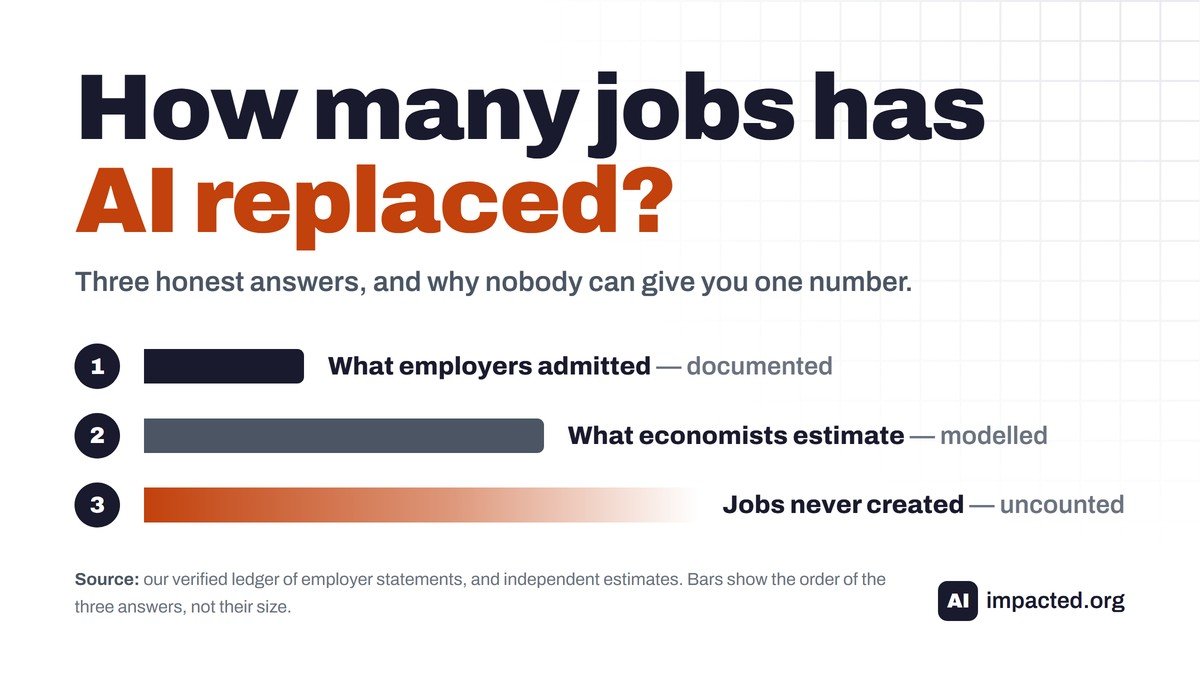
Short answer: Employers themselves have attributed 81,486 job losses to AI across 42 companies in the twenty months to August 2026 - the only figure that is documented rather than modelled. Independent estimates put the real total higher but still small: Morningstar reckons AI has cut at most a few hundred thousand US jobs, about 0.1% of employment. The largest effect, jobs never created, is not counted by anyone.
There is no single number, and anyone who hands you one is making a choice they usually do not explain.
Ask how many jobs AI has replaced and you will get a forecast (a consultancy projecting 2030), a tracker total (every layoff a journalist called an AI layoff), or a shrug. Those are three different questions. Below are three answers that can actually be checked, from the smallest and most defensible to the largest and most uncertain.
#Answer one: 81,486 jobs, because the employer said so
The narrowest honest answer counts only cases where the employer itself said AI did work people used to do - in a regulatory filing, a memo, or an on-record interview. Not an analyst inferring it. Not a journalist inferring it. The company, in its own words.
As of 3 October 2026 that ledger holds 42 employers and 81,486 jobs, spanning twenty months from January 2025 to August 2026.
| Employer | Jobs |
|---|---|
| Oracle | 21,000 |
| Citigroup | 20,000 |
| HP | 5,000 |
| Salesforce | 4,000 |
| Block | 4,000 |
| Lufthansa | 4,000 |
| DBS | 4,000 |
| Visa | 2,600 |
| Acrisure | 2,250 |
| WiseTech Global | 2,000 |
| OpenText | 1,600 |
| Allianz | 1,500 |
| C.H. Robinson | 1,387 |
| Cloudflare | 1,100 |
| Snap | 1,000 |
| Livspace | 1,000 |
| Coinbase | 700 |
| Paycom | 540 |
| Freshworks | 500 |
| CrowdStrike | 500 |
| Just Eat Takeaway | 450 |
| Groupon | 400 |
| Angi | 350 |
| ClickUp | 290 |
| Fiverr | 250 |
| DeepL | 250 |
| IBM | 200 |
| Redis | 200 |
| Artlist | 200 |
| Jumia | 200 |
| Infopro Digital | 19 |
| Cognizant | not disclosed |
| Upwork | not disclosed |
| Domain Money | not disclosed |
| Elastic | not disclosed |
| Gambling.com Group | not disclosed |
| Boozt | not disclosed |
| lastminute.com | not disclosed |
| Mews | not disclosed |
| Bird | not disclosed |
| Monte Carlo | not disclosed |
| Baker McKenzie | not disclosed |
Two things about that list matter more than the total.
It is extremely concentrated. Two employers - Oracle and Citigroup - account for 41,000 of the 81,486 jobs, or 50%. Three industries (banking and finance, IT, transport and logistics) account for 86%. This is not yet an economy-wide phenomenon. It is a small number of very large employers in a few sectors.
And it is a floor, not a total. It counts only what companies were willing to say out loud. Every employer that quietly replaced work with software and called it a restructuring is absent by design.
#What the bar excludes, and why that is most of it
The gap between "a company cut jobs and mentioned AI" and "a company said AI does the work" is where almost every inflated number comes from. Three cases show the difference.
Zscaler cut about 3% of its staff and told the SEC it was "strategically reallocating resources to provide additional capacity to support our AI and growth initiatives". Read quickly, that is an AI layoff. Read exactly, it is a budget being moved toward AI - a spending decision, not a machine doing anyone's job. It produces no event here.
Uber cut 3,300 people while committing more than $10 billion to autonomous vehicles, and its chief executive went out of his way to say the cuts were not about AI - the savings, he told investors, would go into lower fares. An employer actively declining the AI explanation is worth more than a dozen analysts asserting it.
Intuit told the SEC it would reduce its workforce by about 17%, roughly 3,000 roles. The filing exists, the number is real, and the stated reason is not AI replacing the work. It is in our archive as an article and not in the ledger as an event.
We also check our own rejections. Every rejected lead the pipeline actually fetched is re-read against its primary source, and of 230 such judgements recorded so far, 16 were overturned - about 7%. That is the error rate on exclusions, published deliberately, because a standard this strict is only trustworthy if someone audits what it discards.
One qualifying case still gives no figure at all: Upwork's chief executive said AI lets smaller teams do the work, without saying how many of the roughly quarter of staff cut that accounts for. It counts as an event and contributes nothing to the total - which is why 42 employers produce 31 numbers.
#Answer two: a few hundred thousand, or about 0.1% of US employment
The second answer comes from outside the ledger. Morningstar senior US economist Preston Caldwell estimates that AI has subtracted at most a few hundred thousand American jobs so far - roughly 0.1% of total US employment.
His method is worth understanding, because it shows how hard the counting is. White-collar services employment - finance, IT, professional services, corporate offices - has fallen about 0.4% a year since 2024. Measured against its 2017-19 trend, the shortfall is around 600,000 jobs. Caldwell calls even that an overestimate, because most of the decline since the 2023 peak corrects the overstaffing built up in 2020-22, and because the declines never accelerated through 2025 and 2026 as adoption spread and AI agents arrived. If AI were doing the cutting, the curve should have bent when the tools got good. It did not.
So the two credible answers are 81,486 admitted and perhaps a few hundred thousand in reality. Both are far below the numbers that circulate. One widely cited tracker reports 116,947 jobs replaced by AI across 32 companies - not a dishonest figure, but a different standard, built largely from news coverage rather than from employers' own claims. When a number is that much larger, the interesting question is always what it counts.
#Why one company can give you three different answers
Oracle is the clearest example of why this resists counting, because all three of the following are true at once.
Its annual filing tells the SEC that "the adoption and deployment of AI technologies across our operations have resulted, and may continue to result, in reductions to our workforce". That is about as explicit as corporate language gets, and it is a legal document rather than a press release.
Its headcount fell from roughly 162,000 to about 141,000 over the year to May 2026 - about 21,000 people, or 13%. But that figure is a net decline between two annual filings. It includes resignations, retirements and every other kind of exit. Oracle has never published how much of it AI accounts for.
And the email sent to affected staff in September said only that, "after careful consideration of Oracle's current business needs", their role was being eliminated "as part of a broader organisational change". AI is not mentioned. No total is given. The same week, Oracle raised the estimated cost of that restructuring to about $2.8 billion.
Three documents, one company, no contradiction - and no way to get from them to "AI replaced N jobs at Oracle". Every tracker that prints 21,000 in an AI-layoffs column is making an assumption the company itself declined to make.
#Answer three: the number nobody counts
The largest effect probably is not layoffs at all. It is the job that is never advertised, and it produces no announcement, no filing and no WARN notice - so it appears in no tracker, including ours.
Some measurements of that channel do exist. In the tenth Big Games Industry Employment Survey, run by recruiter Values Value with the InGame Job platform across 1,800 respondents in 90 countries, 35% of game founders said they had decided not to hire someone because "AI tools could handle the work instead". Not a redundancy - a vacancy that was never opened.
Entry-level work looks most exposed. Analysis of job postings suggests AI has quietly erased up to 9% of entry-level listings. And in Morningstar's data the one indicator pointing the other way is generational: unemployment among 23-to-25-year-olds holding a bachelor's degree or higher now sits near 6%, against 3.6% in 2019 - a step up Caldwell calls plausibly AI-driven.
If you are early in your career, this is the number that should concern you, and it is precisely the one that cannot be counted.
#The evidence pointing the other way
An honest answer has to include the findings that cut against the thesis, because there are several and they are not weak.
Payroll data from Gusto, comparing 1,593 small businesses that adopted AI against 669 that did not, found the adopters grew headcount about 7% more over the following year. Among firms with fewer than 10 employees the gap was about 10%, and among small health care and social assistance practices nearly 20%. The new hires were hands-on and customer-facing: teachers, technicians, cooks, dental hygienists, front-desk staff.
US technology employment grew by about 86,000 workers in August, in the same month tech companies were announcing cuts. And Wipro says AI now covers the output of 20,000 employees - and redeployed them instead of cutting them, which is the outcome this site records as no job loss at all.
There is also reason to doubt that "replaced" is permanent. Gartner expects roughly 30% of roles eliminated because of AI to be refilled by 2029, at higher cost, as companies discover what the tools could not actually do.
#So: how many jobs has AI replaced?
The defensible range, as of October 2026:
- 81,486 jobs across 42 employers have been attributed to AI by the employers themselves - the floor, and the only part that is documented rather than estimated.
- Perhaps a few hundred thousand US jobs, around 0.1% of employment, on the best independent estimate - and even that is called an overestimate by the economist who made it.
- An unknown and probably larger number of jobs never created, concentrated at entry level, which no method currently captures.
Set against roughly 160 million employed Americans, the documented displacement is small. Set against a graduate trying to enter a shrinking pipeline of junior roles, it is not small at all. Both statements are true, and most arguments about AI and jobs are really arguments about which one you are looking at.
#How to check the next number you are shown
When a figure for AI-replaced jobs appears, four questions separate a count from a guess:
- Who said AI did it? The employer, or someone writing about the employer?
- Where did they say it? A filing is a legal document. A press release is messaging.
- Is there a number on the AI itself, or only on the layoff - with AI named separately nearby?
- Is it a headcount decline or an announced cut? A year-on-year fall includes everyone who simply left.
Our own ledger fails the third test more often than we would like, which is why the total above is a floor and labelled as one. Every case behind it is listed with the filing, memo or interview it came from, so you can disagree with any individual entry - and if you think one does not belong, we would rather hear it.
Related: Will AI take my job? We checked every employer that said it did.
Questions people ask
- How many jobs has AI replaced?
- 42 employers have attributed 81,486 job losses to AI in their own filings, memos or on-record statements in the twenty months to August 2026. That is a floor, not a total, because it counts only what companies admitted. Morningstar's independent estimate is that AI has subtracted at most a few hundred thousand US jobs so far, roughly 0.1% of total employment.
- Which companies have said AI replaced their staff?
- Oracle (21,000), Citigroup (20,000), HP (5,000), Salesforce (4,000), Block (4,000), Lufthansa (4,000), DBS (4,000), Visa (2,600), Acrisure (2,250), WiseTech Global (2,000), OpenText (1,600), Allianz (1,500), C.H. Robinson (1,387), Cloudflare (1,100), Snap (1,000), Livspace (1,000), Coinbase (700), Paycom (540), Freshworks (500), CrowdStrike (500), Just Eat Takeaway (450), Groupon (400), Angi (350), ClickUp (290), Fiverr (250), DeepL (250), IBM (200), Redis (200), Artlist (200), Jumia (200), Infopro Digital (19), and Upwork, Cognizant, Domain Money, Elastic, Gambling.com Group, Boozt, lastminute.com, Mews, Bird, Monte Carlo and Baker McKenzie (no figure disclosed). Two of them account for half of the total and three industries account for 86%.
- Why is there no single reliable number for AI job losses?
- Because the three available measures disagree by design. A company's filing may name AI as a cause without giving a count; a year-on-year headcount fall includes resignations and retirements; and the notice sent to staff often gives a different reason entirely. Oracle is all three at once: a filing naming AI, a 21,000 net decline, and a termination email citing “current business needs”.
- Is AI actually reducing total employment?
- Not measurably, so far. US technology employment grew by about 86,000 in August 2026, small businesses that adopted AI grew headcount about 7% faster than those that did not, and Gartner expects roughly 30% of AI-attributed cuts to be refilled by 2029. The clearest damage is at entry level, where up to 9% of junior postings have disappeared.