Will AI take my job? We checked every employer that said it did
Short answer: Forty-two employers have attributed 81,486 job losses to AI in their own filings, memos or on-record statements in the twenty months to August 2026. Only fourteen said it in a regulatory filing. Two companies account for half of the total and three industries for 86%, so this is a concentrated pattern among very large employers rather than a broad shift in the labour market.
Almost every answer to this question is a forecast. A consultancy projects a percentage, a chief executive predicts a transformation, an economist models an exposure score. Forecasts are cheap, and by the time they can be checked nobody is checking.
So we do something narrower and duller. We record only the cases where the employer itself said AI did the work - in a filing, a memo, or an on-record interview. Not analysts inferring it. Not journalists inferring it. The company, in its own words.
As of 3 October 2026 that list has forty-two companies on it and 81,486 jobs. It is a small list, deliberately. What makes it useful is not its size but what stays out of it.
#The standard, and why it excludes so much
An employer saying "we are reallocating budget toward AI" is describing a spending decision. An employer saying AI now does work people used to do is describing a displacement. Only the second one counts here.
That distinction removes a great deal of what gets reported as an AI layoff. Microsoft explicitly said its cuts were not AI replacing roles. Cisco, Meta, Uber and Pinterest all announced cuts while talking about AI investment, without ever claiming AI was doing the work. Those are real layoffs and real hardship, and none of them tells you an algorithm took a job.
The scale of that gap is the single most useful number here. We have published 150 posts on AI and jobs; forty-two of them clear this bar. More than two in three reports of AI-driven job cuts turn out, on inspection, not to contain the employer claiming AI did the work at all.
Gartner has now put a name to part of the reason. Its analyst Tori Paulman told Computerworld the firm found widespread "AI washing": executives who need to cut headcount for ordinary budgetary reasons and then blame AI, because it makes them look better
. Blaming a robot reads as strategy. Admitting you overhired reads as a mistake.
#The forty-two
| Employer | Jobs | Share of staff | The receipt |
|---|---|---|---|
| Oracle | 13% of company | SEC FILING“the adoption and deployment of AI technologies… have resulted… in reductions to our workforce” | |
| Citigroup | 8% global | CEO MEMOJane Fraser: “automation, AI and further process simplification” | |
| HP | 4,000-6,000 planned | SEC FILING“primarily through artificial intelligence adoption and enablement, and the resulting efficiencies, including those that enable a reduction in workforce” | |
| Block | 40% | SHAREHOLDER LETTERJack Dorsey: “a significantly smaller team… can do more and do it better” | |
| Lufthansa | admin FTE by 2030 | COMPANY RELEASE“the increased use of artificial intelligence will lead to greater efficiency in many areas and processes” | |
| DBS | contract staff, 3 yrs | COMPANY STATEMENT“AI could reduce the need to renew about 4,000 temporary/ contract staffrenew about 4,000 temporary/contract staff”rdquo; | |
| Visa | 7% | CEO MEMORyan McInerney: AI is “helping to accelerate this evolution and shape the way work gets done at Visa” | |
| WiseTech Global | 29% | ASX RELEASEZubin Appoo: “the era of manually writing code as the core act of engineering is over” | |
| OpenText | part of a 2,000 net cut | SEC FILINGMark Barrenechea: “It’s just going to be done with a machine via AI” | |
| Acrisure | 11% | CEO MEMOGreg Williams: “Advances in technology, AI, and digital platforms are fundamentally changing how businesses operate” | |
| Allianz | ~7% of Allianz Partners | CEO ON RECORDTomas Kunzmann confirmed 1,500 to 1,800 cuts at the travel-insurance arm, which cited AI as a reason | |
| Salesforce | support: 9,000→5,000 | CEO ON RECORDMarc Benioff: AI agents handle ~half of customer interactions; support costs down 17% | |
| C.H. Robinson | ~4% of staff | SEC FILINGAI-driven solutions named for headcount reductions in the company’s own filing | |
| Cloudflare | 20% | CEO ON RECORDMatthew Prince: “the vast majority of those we laid off… were measurers” | |
| Snap | 16% | CEO ON RECORDEvan Spiegel: AI lets “small squads” cut repetitive work | |
| Livspace | ~12% | COMPANY STATEMENT“tasks that were previously manual are now handled by intelligent systems” | |
| Coinbase | 14% | SEC FILINGoptimising “the Company’s operations for the AI era”, alongside market conditions | |
| Paycom | ~8% | SEC FILING“Automating our core business systems… led to reductions in headcount” | |
| Freshworks | ~11% | CEO NOTEDennis Woodside: “Our systems can now handle many of the manual tasks and fragmented handoffs” | |
| CrowdStrike | ~5% | SEC FILINGGeorge Kurtz: “AI flattens our hiring curve” | |
| Just Eat Takeaway | <5% | SPOKESPERSON“transitioning manual customer service tasks to automated systems” | |
| Groupon | up to 400 roles | SEC FILINGplan relates to its strategy “to rebuild the Company as an AI-native company” | |
| Angi | 12.5% | SEC FILINGcuts made “in light of AI-driven efficiency improvements” | |
| Infopro Digital | 19 posts across 26 titles | COMPANY DISCLOSED19 sub-editors to be replaced by five “chief editor” posts working with AI; a French court suspended part of the plan | |
| Elastic | ~7% of staff | CEO NOTEAsh Kulkarni: “advances in AI and automation are letting us operate with leaner teams” | |
| ClickUp | 22% of staff | CEO MEMOZeb Evans: engineers are “not writing code. They’re directing agents that write code” | |
| Fiverr | not stated | SEC FILINGMicha Kaufman: “we don’t need as many people to operate the existing business” | |
| DeepL | not stated | CEO LETTERJarek Kutylowski: “that shift is because of AI” | |
| IBM | HR function | CEO ON RECORDArvind Krishna: AskHR now automates 94% of routine HR tasks | |
| Redis | not stated | CEO MEMORowan Trollope: AI “changes how we work”; product and engineering “moving to smaller teams” | |
| Artlist | roles under review | CO-CEO ON RECORDIra Belsky: “AI makes certain roles redundant” | |
| Jumia | at least 200 more | SEC FILING“AI-driven automation… enabled a reduction in our headcount” | |
| Cognizant | not stated | SEC FILINGa workforce “properly sized, AI-enabled”, through “AI-led efficiencies” | |
| Upwork | ~25% | CEO ON RECORDHayden Brown: the company moves faster with smaller teams | |
| Domain Money | ~a third of staff | FOUNDER ON RECORDAdam Dell: cuts followed “improved automation and efficiency”, letting one advisor serve up to 150 clients | |
| Gambling.com Group | 25% of staff | SEC FILING“This shift to AI-first working principles enables a proposed restructure of teams” | |
| Boozt | ~10% of permanent staff | COMPANY RELEASEHermann Haraldsson: “resizing our workforce to align with the efficiencies gained” | |
| lastminute.com | ~25% | COMPANY RELEASEAlessandro Petazzi: work that “will be doable by AI” | |
| Mews | 15% | FOUNDER ON RECORDRichard Valtr: “a singular employee can do so, so much more with AI” | |
| Bird | ~20% | FOUNDER NOTERobert Vis: “tasks that required dedicated headcount even a few years ago no longer do” | |
| Monte Carlo | 30% | CEO ON RECORDBarr Moses: “AI enabling smaller, more focused groups” | |
| Baker McKenzie | business services | SPOKESPERSON“rethinking the ways in which we work, including through our use of AI” |
Twenty months separate the oldest entry from the newest. That is the entire verified record of employers admitting AI did the work, and it is worth sitting with how short it is.
Look down the right-hand column and one thing stands out: only fourteen of the forty-two said it in a regulatory filing. Oracle, HP, Cognizant, Angi, Coinbase, C.H. Robinson, Groupon, Gambling.com, WiseTech Global, OpenText, Paycom, CrowdStrike, Fiverr and Jumia made the claim in documents where being wrong has legal consequences. The other twenty-eight said it in a memo, a shareholder letter or an interview - venues where an executive can sound decisive at no cost. Both kinds count here, because in both the employer made the claim in its own name. But they are not the same weight of evidence, and the table is arranged so you can see which is which.
#What they have in common
Three things, and none of them is "AI is coming for everyone".
It is extraordinarily concentrated. Two companies - Oracle and Citigroup - account for 41,000 of the 81,486 jobs, or 50%. This is not a broad economic pattern. It is a handful of very large employers making very large decisions, and a long tail of everyone else.
It clusters in three industries. Banking and finance (35,050), information technology (29,450) and transport and logistics (5,387) together account for 86% of the total. Customer support, software, retail, entertainment and a handful of smaller cases make up the remainder. If you work outside those three sectors, the verified record currently has almost nothing to say about you.
Most are layoffs, not replacements. Only nine of the forty-two - Salesforce's, Just Eat Takeaway's and Jumia's customer service, IBM's HR function, Paycom's payroll back office, OpenText's help desks and document generation, Infopro Digital's sub-editors, and ClickUp's and WiseTech's code-writing - describe a specific human process handed to a machine. The other thirty-three are cost reductions where AI was named as the enabling reason. The distinction matters: a replacement tells you a task is gone, a layoff tells you a budget shrank.
#The part nobody quotes
IBM is on this list for cutting 200 HR roles to an AI system. It is also the case that most complicates the story, because the same company then hired more programmers and more salespeople with the savings. The headcount moved rather than vanished.
Gartner expects that pattern to become common enough to have a shape. It forecasts that 30% of roles eliminated in AI-related layoffs will be refilled by 2029, rising to roughly 40% at large enterprises - and refilled at a higher cost than they were cut. Other analysts are sceptical that this proves the original cuts were errors; work may be offshored, contracted out, or quietly absorbed by whoever is left. But nobody in that debate is arguing the jobs simply disappeared.
#What a verified case actually looks like
Two entries show why the standard is worth the work.
Oracle is on the list because of where it said it, not how loudly. Its headcount fell from 162,000 to 141,000 in the year to 31 May 2026, and its annual SEC filing states that the adoption and deployment of AI technologies across our operations have resulted, and may continue to result, in reductions to our workforce
. That is the first time a large technology company put AI-driven job losses in a federal filing rather than a press release. Restructuring costs hit $1.84 billion, up from $374 million a year earlier, while capital expenditure rose 162% to $55.7 billion - most of it on AI data centres. A filing is a legal document. It is much harder to dismiss as marketing.
Salesforce is on the list because it named the work. Marc Benioff said the customer support team went from 9,000 people to 5,000 while AI agents took on roughly half of all customer interactions, and support costs fell 17%. There is a specific function, a specific volume of work, and a number attached. Compare that with the standard formulation - "we are becoming an AI-first company" - which names nothing and can be said by anyone about anything.
#Who is actually being hit
The most credible evidence that AI is displacing anyone at scale is not about industries. It is about age.
Stanford researchers working with the payroll processor ADP examined employment data through June 2026 and found no broad AI-driven decline across the economy. What they did find was a gap at the entry level: employment of workers aged 22 to 25 in AI-exposed occupations fell about 11% from late 2022, while the same age group in less-exposed occupations grew about 10%. By June, the exposed group sat roughly 19% below their peers.
Older, more experienced workers showed no comparable gap. The researchers' explanation is uncomfortable and plausible: AI is good at the routine, well-specified work that junior staff are hired to do, while experienced workers use the same tools to do more of work they already own.
So the honest version of the risk is not "AI takes your job". It is closer to: AI removes the job you would have been hired into.
#The case that complicates all of this
If the entry-level story were the whole story, Cloudflare would not fit it.
The company cut more than 1,100 roles - about 20% of its workforce - on 7 May 2026, the same day it reported record quarterly revenue of $639.8 million, up 34% year on year. Chief executive Matthew Prince was unusually specific about who went: the vast majority of those we laid off last week were measurers
, a category he defined as middle management, finance, legal, internal auditing and revenue recognition.
That is not entry-level work. It is the oversight layer - the people who count, check and report on work rather than perform it. Prince's claim is that agentic AI collapsed the cost of measuring things, and the roles that existed to measure went with it.
One company is not a trend, and record revenue alongside a 20% cut invites other explanations. But it is a live counter-example to the assumption that automation eats upward from the bottom, and it comes from an employer saying it on the record. If your job is largely measuring someone else's output, Prince has told you what he thinks happens next.
#How to read your own employer's announcement
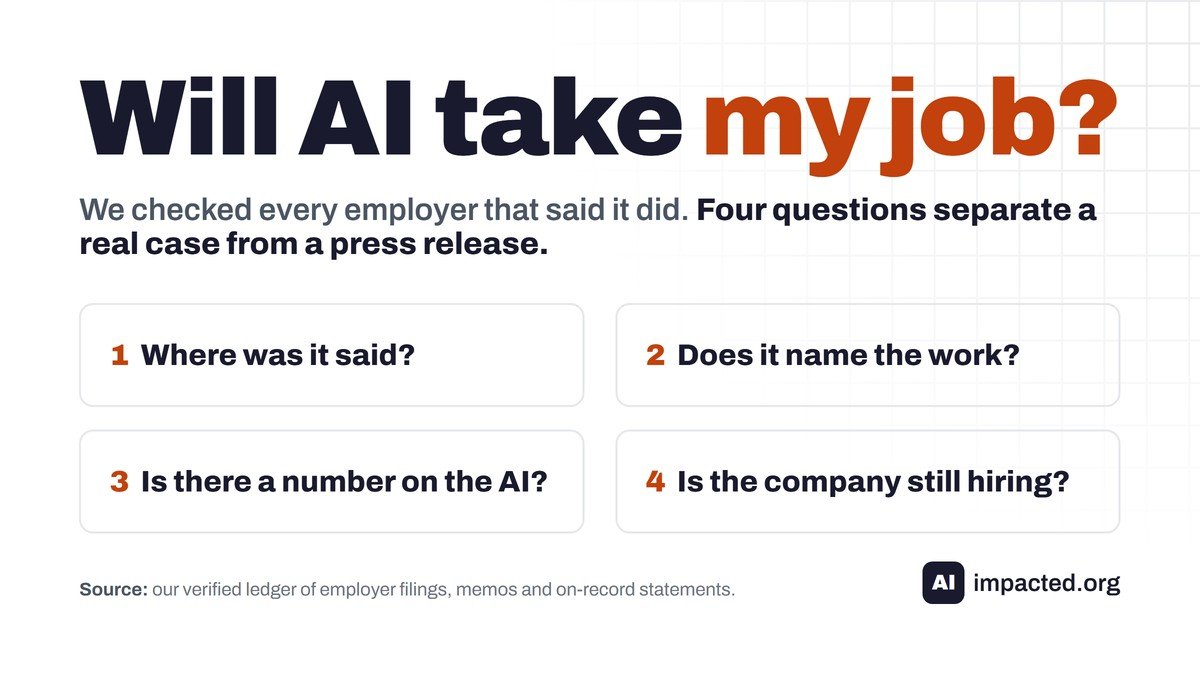
Four questions separate a real displacement from a press release, and you can apply them to any announcement in about a minute.
Where was it said? A regulatory filing carries legal consequences for being untrue. A press release, an all-hands and a podcast do not. Oracle is the strongest entry on our list purely because of this.
Does it name the work? "AI agents handle half our customer interactions" is checkable. "Becoming an AI-first organisation" is not. Vagueness is the tell.
Is there a number attached to the AI, specifically? HP told the SEC that a reduction of 4,000 to 6,000 jobs would come “primarily through artificial intelligence adoption and enablement”. That is a falsifiable commitment. Most announcements attach a number to the layoff and nothing to the cause.
Is the company still hiring? IBM cut 200 HR roles to a bot and then hired more programmers and salespeople. If headcount is moving rather than shrinking, you are watching a reallocation - which may still cost you your job, but is not automation replacing human work.
#So - will AI take my job?
On the evidence that can actually be checked, here is the fair answer.
Probably not this year, and probably not because of AI specifically. Forty-two employers in twenty months, half of it from two companies, is not a wave. If your employer cuts your job, the likeliest honest explanation remains cost, overhiring or a bad quarter - and Gartner's finding is that a meaningful share of firms will blame AI for exactly those decisions anyway.
The risk is real but narrow. It concentrates in finance, IT and logistics; in large employers; in well-specified, high-volume work such as customer support and HR administration; and above all at the entry level, where the Stanford data shows a measurable 11% decline already.
The thing to watch is not announcements but filings. Oracle's 21,000 is on this list because it appeared in an SEC filing, where saying it carries legal weight. Press releases are marketing. Filings are testimony.
And be suspicious of the number in the headline. Large aggregate totals for AI job losses circulate constantly, and most are built without a stated standard - mixing employer admissions with analyst inference, forecast headcount and ordinary restructuring that mentioned AI somewhere. Before trusting a total, ask what it counts. Every event behind the 81,486 above is named, dated and linked to its source, so ours can be checked line by line.
If you want the raw record rather than the summary, every event above links to the original filing or report. We would rather you checked.
Questions people ask
- Will AI take my job?
- Probably not this year, and probably not because of AI alone. Forty-two employers in twenty months have said AI did work people used to do, covering 81,486 jobs, and half of that comes from two companies. If your job is cut, the likeliest honest explanation remains cost, overhiring or a bad quarter.
- Which companies have said AI replaced their staff?
- Oracle, Citigroup, Cognizant, HP, Salesforce, Block, Lufthansa, DBS, Visa, Acrisure, WiseTech Global, OpenText, Allianz, C.H. Robinson, Cloudflare, Snap, Livspace, Coinbase, Paycom, Freshworks, CrowdStrike, Just Eat Takeaway, Groupon, Angi, ClickUp, Fiverr, DeepL, IBM, Redis, Artlist, Jumia, Infopro Digital, Elastic, Upwork, Domain Money, Gambling.com Group, Boozt, lastminute.com, Mews, Bird, Monte Carlo and Baker McKenzie. Only Oracle, HP, Cognizant, Angi, Coinbase, C.H. Robinson, Groupon, Gambling.com, WiseTech Global, OpenText, Paycom, CrowdStrike, Fiverr and Jumia said it in a regulatory filing; the rest said it in a memo, a shareholder letter or an interview.
- What is AI-washing?
- Blaming AI for a cut that had another cause. Gartner analyst Tori Paulman has described companies using AI as cover for reductions driven by cost or overhiring: naming a robot reads as strategy, while admitting you overhired reads as a mistake. It is why most reported AI layoffs do not survive checking.
- Which jobs are most at risk from AI?
- On the evidence so far, entry-level and measurement work rather than whole professions. Only nine of the forty-two cases - Salesforce's, Just Eat Takeaway's and Jumia's customer service, IBM's HR function, Paycom's payroll back office, OpenText's help desks and document generation, Infopro Digital's sub-editors, and ClickUp's and WiseTech's code-writing - describe a specific human process handed to a machine. The clearest harm is to people trying to enter the workforce, where junior postings have thinned.