Hiring freezes, not pink slips: how AI is actually replacing jobs in 2026
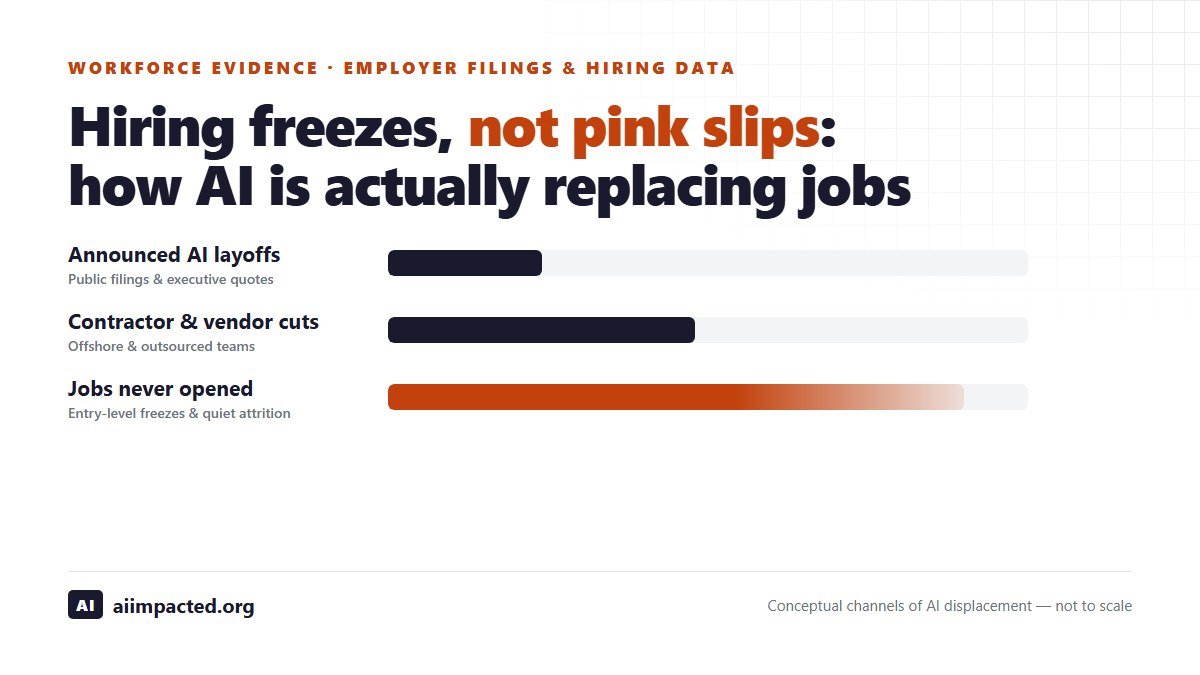
Short answer: As of 26 November 2026, 67 employers have publicly attributed 93,709 job cuts to AI, led by Banking & Finance (44,412) and IT (29,450). Yet Anthropic's November 2026 study of 58 companies found two-thirds cut hiring because of AI while direct layoffs were rare—showing that AI is replacing jobs mostly through hiring freezes and contractor cuts rather than pink slips.
If you only watch layoff announcements to measure whether AI is replacing jobs, you are looking at the smallest door in the building.
In the public record as of 26 November 2026, 67 employers have attributed 93,709 job cuts to AI in their own filings, memos, and on-record statements. Meanwhile, in a 23 November 2026 field study of 58 US companies using its models, Anthropic found that two-thirds had reduced hiring because of AI—while direct layoffs from AI automation were rare, occurring at only two firms in the sample.
Both facts are true at the same time. Together, they explain the central paradox of the 2026 labor market: headline unemployment has barely moved, yet early-career workers, offshore contractors, and back-office teams are feeling a sharp squeeze. AI is replacing work primarily through unopened requisitions, non-renewed vendors, and quiet attrition—not mass severance announcements.
#What employers actually admitted: 93,709 jobs across 67 companies
Our AI layoffs tracker applies a strict evidentiary bar: an event is counted only when the employer itself states in a regulatory filing, internal memo, earnings call, or named interview that AI is doing the work. Cuts merely announced alongside AI spending are excluded.
As of 26 November 2026, that verified ledger holds 67 events and 93,709 jobs spanning January 2025 to November 2026 (with 42 events disclosing a headcount figure and 25 disclosing only a percentage or qualitative cut). What stands out is how narrowly those cuts are concentrated:
| Sector | Verified Events | Verified Jobs | Share of Ledger |
|---|---|---|---|
| Banking & Finance | 17 | 47.4% | |
| Information Technology | 10 | 31.4% | |
| Transportation & Logistics | 2 | 5.7% | |
| Customer Service & Support | 1 | 4.3% | |
| Software Development | 16 | 3.5% |
Three numbers tell the story of the verified record:
- 43.8% from two companies: Oracle (21,000) and Citigroup (20,000) account for 41,000 of the 93,709 documented jobs.
- 84.6% from three industries: Banking & Finance, Information Technology, and Transportation & Logistics account for 79,249 of the verified total.
- 52.7% in the United States: 30 US events account for 49,385 jobs, followed by worldwide restructurings (11 events, 27,100 jobs) and Germany (4 events, 6,550 jobs, led by Vodafone and Lufthansa).
For an economy of roughly 160 million US workers alone, 93,709 global admitted cuts over 22 months is not a macro shock. If that were the entire effect of AI on employment, workers would barely notice it.
#Why the real displacement happens before a job is ever posted
The reason workers feel more pressure than the layoff ledger shows is that firing existing staff is expensive, noisy, and legally slow—while not hiring their replacement costs nothing and triggers zero filings.
In Anthropic's 23 November 2026 study—based on 66 face-to-face interviews across 58 US companies deploying Claude—interviewees at two-thirds of firms reported reducing hiring because of AI. Six startups in the sample estimated they would need, on average, four times as many employees without AI. As one interviewee summarized the shift: "We may not be firing, but we're not hiring."
Two groups absorb that silent contraction first:
- External and offshore contractors: Many firms in the Anthropic sample trimmed vendor and contractor headcount rather than full-time staff—including one finance company that downsized well over 100 offshore data and developer contractors without a domestic layoff announcement.
- Entry-level and junior applicants: Federal Reserve Governor Lisa Cook warned in November 2026 that AI disruption is concentrated in software coding and entry-level hiring even while headline employment holds steady, backed by San Francisco Fed research estimating a 0.2-point rise in the natural rate of unemployment. Morningstar's labor data shows unemployment among 23-to-25-year-old degree holders sitting near 6%, up from 3.6% in 2019.
An unopened requisition creates no WARN notice, no SEC restructuring charge, and no press release. Every tracker—including ours—misses it by definition.
#The 3-layer gap: what different trackers are actually measuring
Confusion in the press usually comes from mixing three incompatible yardsticks. Comparing them side by side makes the discrepancy obvious:
| Measure | What It Counts | Current Scale | Blind Spot |
|---|---|---|---|
| Employer-attributed ledger (AIimpacted) | Filings, memos & quotes where the employer says AI does the work | 93,709 jobs (67 employers) | Misses quiet attrition & hiring freezes |
| Stated-reason trackers (Challenger, Gray & Christmas) | US job cuts where AI is cited as an announcement reason | 120,136 US cuts (Jan–Sep 2026) | Records PR framing, not actual AI replacement |
| Hiring-freeze & contractor channel (Anthropic / Fed / Gusto) | Unfilled junior roles, vendor cuts & productivity substitution | 2/3 of surveyed adopters cut hiring | No company-by-company headcount ledger |
Challenger, Gray & Christmas data illustrates why stated reasons need scrutiny: US employers cited AI in 120,136 of 573,195 announced cuts across the first nine months of 2026 (about 21%), yet AI dropped to fifth place in September with 3,961 cuts. Andy Challenger himself cautioned that citing AI can appeal to investors while alienating staff. When a company tells Wall Street it is "reallocating resources to AI" while trimming headcount, that is often a budget decision—not proof an algorithm is doing the job.
Our own verification rules exclude those spending-reallocation cuts—for example, Zscaler and Uber—which is why our verified floor sits below headline US announcement totals.
#The reversal signal: "AI rebounding" is already happening
Even where companies did cut staff for AI, the replacement has not always stuck. Several 2026 datasets point to a growing boomerang effect:
- Workers seeing rehires: A November 2026 survey by SHL across US and UK workers found that 52% have encountered "AI rebounding"—companies rehiring employees previously replaced by AI, often at higher pay (with 19% of US respondents and 13% of UK respondents reporting firsthand experience).
- Forecasted reversals: Gartner projects that roughly 30% of roles eliminated due to AI will be refilled by 2029 as firms hit quality, security, and oversight bottlenecks.
- Code review and audit limits: In software engineering and financial auditing—such as KPMG's 2026 Project Exponential trial—AI tools accelerated draft generation but still required experienced humans to catch regulatory errors, review generated code, and sign off on outputs.
The pattern is consistent: AI is strongest at compressing the bottom of the hiring funnel (junior coding, routine support, offshore data work) and weakest at replacing senior judgment. Cutting experienced staff too early forces firms to hire them back; freezing junior hiring leaves fewer people entering the pipeline to become senior later.
#What this means if you are working or job-hunting
If you are trying to read your own job risk from the news, three practical rules separate signal from noise:
- Watch hiring velocity in your team, not just layoff headlines. When backfills stall for three months while leadership pushes AI copilots, headcount is shrinking by attrition.
- Track task ownership, not job titles. Look at whether your role ends at producing a first draft (most exposed) or owns verification, client trust, compliance sign-off, and cross-system debugging (where firms are rehiring).
- Check primary sources on your employer. Before assuming a restructuring is permanent AI replacement, read the company's actual filing or memo—many firms in our company directory cite AI for investor positioning while moving work to contractors or cutting unrelated budgets.
Related: How many jobs has AI replaced? Three honest answers · Will AI take my job? We checked every employer that said it did.
Questions people ask
- Is AI replacing jobs mostly through layoffs or hiring freezes?
- Increasingly through hiring freezes and contractor reductions rather than direct layoffs. While 67 employers have attributed 93,709 job cuts to AI as of 26 November 2026, Anthropic's November 2026 study of 58 companies found two-thirds reduced hiring due to AI while only two saw AI automation directly eliminate a role via layoff.
- Which industries have the most verified AI job cuts?
- Three sectors account for 84.6% of the 93,709 verified AI-attributed job cuts as of 26 November 2026: Banking & Finance (44,412 jobs across 17 events), Information Technology (29,450 jobs across 10 events), and Transportation & Logistics (5,387 jobs across 2 events).
- Are companies rehiring workers replaced by AI?
- Yes, in some cases. A November 2026 SHL survey found 52% of US and UK workers had encountered 'AI rebounding'—firms rehiring staff previously cut for AI—and Gartner projects roughly 30% of AI-eliminated roles will be refilled by 2029.
- Why do different AI layoff trackers show different numbers?
- Because they measure different things. AIimpacted counts only the 93,709 cuts where the employer itself stated AI did the work, whereas announcement trackers like Challenger, Gray & Christmas (120,136 US cuts citing AI in Jan–Sep 2026) include broader PR framing, and neither captures unfilled entry-level roles.