Impact of AI on jobs in 2026: what US hiring data shows
Short answer: The impact of AI on jobs is so far smaller in US hiring data than in company announcements. Employers that blame AI for cuts have named customer support, HR, software engineering, management, finance, legal and back-office work as the jobs it replaced. Indeed job postings for those occupations fell steeply from 2022 to mid-2025, before almost every announcement. Since the employers spoke, most have kept pace with or beaten the overall market: in the year to 25 September 2026 software development postings rose 14 points and HR 12, against 2 for all US postings. Customer service is the exception, still edging down. All of them remain below February 2020, from 3% (HR) to 38% (data and analytics), while all US postings are 4% above.
Most of what is written about the impact of AI on jobs is forecast. This is a measurement. When an employer says AI is the reason it cut jobs, it sometimes names the jobs. Salesforce said AI agents let it shrink customer support from 9,000 people to about 5,000. IBM said an AI agent replaced about 200 HR roles. Cloudflare's chief executive said AI ended the need for what he called the measurers in finance, legal and audit. ClickUp, Elastic, Upwork and Redis named engineering. Coinbase named managers who only manage. We set out which jobs employers say AI is replacing in an earlier piece; this one asks what the hiring market did next.
That gives a testable question: after employers said AI took a kind of work, did hiring for that kind of work fall? Indeed Hiring Lab publishes daily US job-postings counts for 47 occupations, indexed to 1 February 2020. We matched every job function an employer named in our AI layoffs tracker to its Indeed occupation, then looked at what postings did before and after each announcement. The data runs to 25 September 2026.
The short answer: the fall in hiring came first, and the AI announcements came after it.
#Key findings
- Postings for the AI-named occupations collapsed between 2022 and 2025, before the AI announcements. Software development postings peaked in February 2022 at 234 (1 February 2020 = 100) and bottomed at 61 in May 2025. HR went from 243 to 83, and customer service from 144 to 81, over the same years. The first announcement in our record that named one of these jobs was IBM's, in May 2025.
- Since the employers spoke, most of the named occupations have kept pace with the market or beaten it. In the year to 25 September 2026, software development postings rose 14 points, HR 12, management 7 and legal 2, while all US postings rose 2. Since IBM's HR announcement in May 2025, HR postings have risen 11 points while the market fell 2.
- Customer service is the exception. Its postings are 1 point lower than a year ago and 12% below February 2020, the only named occupation still edging down after the announcement that named it.
- The jobs falling fastest now are not the AI ones. Over the past year the steepest falls on Indeed are dental (-20 points), education (-12), childcare (-12), driving (-8) and community and social services (-7). No employer in our record has blamed AI for any of them.
- Every AI-named desk job is still below 2020. Data and analytics is 38% below February 2020, the lowest of all 47 occupations; IT operations 31% below; media and communications 29%; marketing 24%; software development 22%; customer service 12%; HR 3%. All US postings are 4% above.
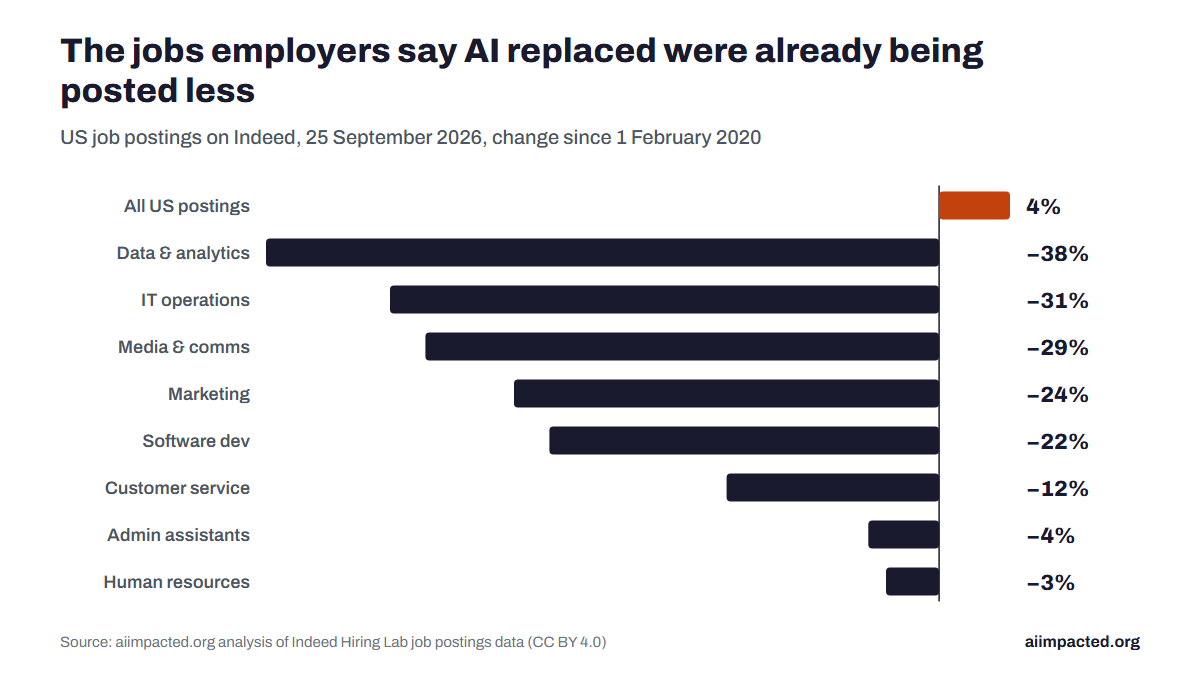
Free to reuse under CC BY 4.0 with the credit: Source: aiimpacted.org analysis of Indeed Hiring Lab job postings data (CC BY 4.0), aiimpacted.org
#How has AI affected the job market so far?
The pattern in the chart above holds for almost every desk occupation an employer has named: a hiring boom that peaked in early 2022, a long slide to a floor in 2025, and a modest recovery since. That timing matters, because the AI announcements in our record cluster in 2025 and 2026. Salesforce's support cut was announced in September 2025. Cloudflare, Coinbase, Upwork, ClickUp and Elastic all spoke between May and June 2026. By then software postings had already lost three quarters of their 2022 peak.
So when an employer says in 2026 that AI is why it needs fewer engineers or support staff, the postings data cannot confirm or deny that claim about that employer. What it can say is that the wider market for those jobs was not shrinking while they said it. It had already shrunk, and was starting to recover.
#Did hiring fall after employers blamed AI?
For each announcement, the table shows how the named occupation's postings index moved from the day of the announcement to 25 September 2026, how all US postings moved over the same days, and the gap between the two. A negative gap means the occupation did worse than the market after the announcement. The small text under each employer's named work is the Indeed occupation it is matched to.
| Employer | Work the employer named | Postings since | All postings | Gap |
|---|---|---|---|---|
| IBM May 2025 | HR (about 200) Human Resources | +11.4 | -2.1 | +13.6 |
| C.H. Robinson Jun 2025 | Back-office processes Admin Assistance | -1.2 | -1.0 | -0.2 |
| Salesforce Sep 2025 | Customer support (4,000) Customer Service | -0.8 | +0.1 | -0.9 |
| Citigroup Jan 2026 | Process and operations Admin Assistance | +0.1 | +1.0 | -0.8 |
| Baker McKenzie Feb 2026 | Business services Admin Assistance | -1.8 | +0.2 | -2.0 |
| Coinbase May 2026 | Managers Management | +2.1 | +1.0 | +1.1 |
| Cloudflare May 2026 | Finance Accounting | +7.9 | +1.2 | +6.8 |
| Cloudflare May 2026 | Legal, audit Legal | +4.9 | +1.2 | +3.7 |
| Cloudflare May 2026 | Middle management Management | +2.1 | +1.2 | +1.0 |
| Upwork May 2026 | Engineering, design Software Development | +3.5 | +1.2 | +2.3 |
| Gambling.com May 2026 | Marketing content Marketing | +0.1 | +2.1 | -2.0 |
| ClickUp May 2026 | Engineers Software Development | +3.9 | +1.8 | +2.1 |
| Elastic Jun 2026 | Engineering Software Development | +4.5 | +2.0 | +2.5 |
| Redis Jul 2026 | R&D Software Development | +2.5 | +2.3 | +0.2 |
| Domain Money Aug 2026 | Financial planning Banking & Finance | +1.8 | +1.8 | 0.0 |
Index points, 1 February 2020 = 100, seasonally adjusted, from each announcement to 25 September 2026.
That is fifteen comparisons from thirteen employers. In ten, the named occupation did as well as or better than the market afterwards. The five that lagged (Salesforce, C.H. Robinson, Citigroup, Baker McKenzie and Gambling.com) lagged by two points or less, which is within the week-to-week noise of these series. Nothing here looks like a market that stopped hiring for a job because a big employer said AI could do it.
#Will AI replace programmers? What software postings show
Software engineering is the job employers name most often. Upwork, ClickUp, Elastic and Redis all said AI let them run with fewer engineers, and ClickUp's chief executive said his engineers now direct agents instead of writing code. If the market agreed, software postings would be falling now. They are doing the opposite: up 14 points in the year to 25 September 2026, from a floor of 61 in May 2025 to 78, the largest rise of any AI-named occupation. They are still 22% below February 2020, so the boom has not returned, but the announcements came after the slump, not before it.
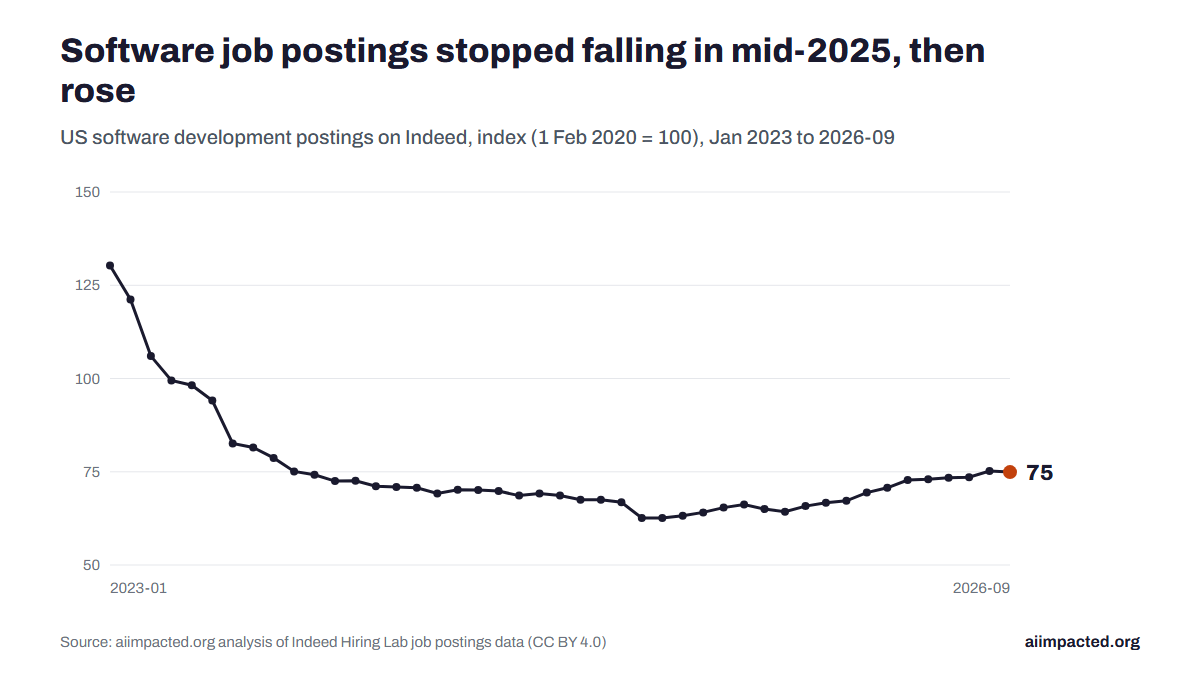
Free to reuse under CC BY 4.0 with the credit: Source: aiimpacted.org analysis of Indeed Hiring Lab job postings data (CC BY 4.0), aiimpacted.org
The chart plots the index on the first day of each month, so its last point is 1 September; the 25 September reading is 78.
#Is AI replacing customer service jobs?
Customer service has the largest single AI-attributed cut in our record, Salesforce's 4,000, and it is the only named occupation whose postings are still edging down: 12% below February 2020 and 1 point lower than a year ago. Indeed also counts fresh postings, listings less than a week old. For customer service they stand at 81 against 88 for all postings in the occupation, a sign that new openings are being added more slowly than old ones are filled or withdrawn. But fresh postings are 3 points higher than a year ago, so the slide in new openings is not getting worse.
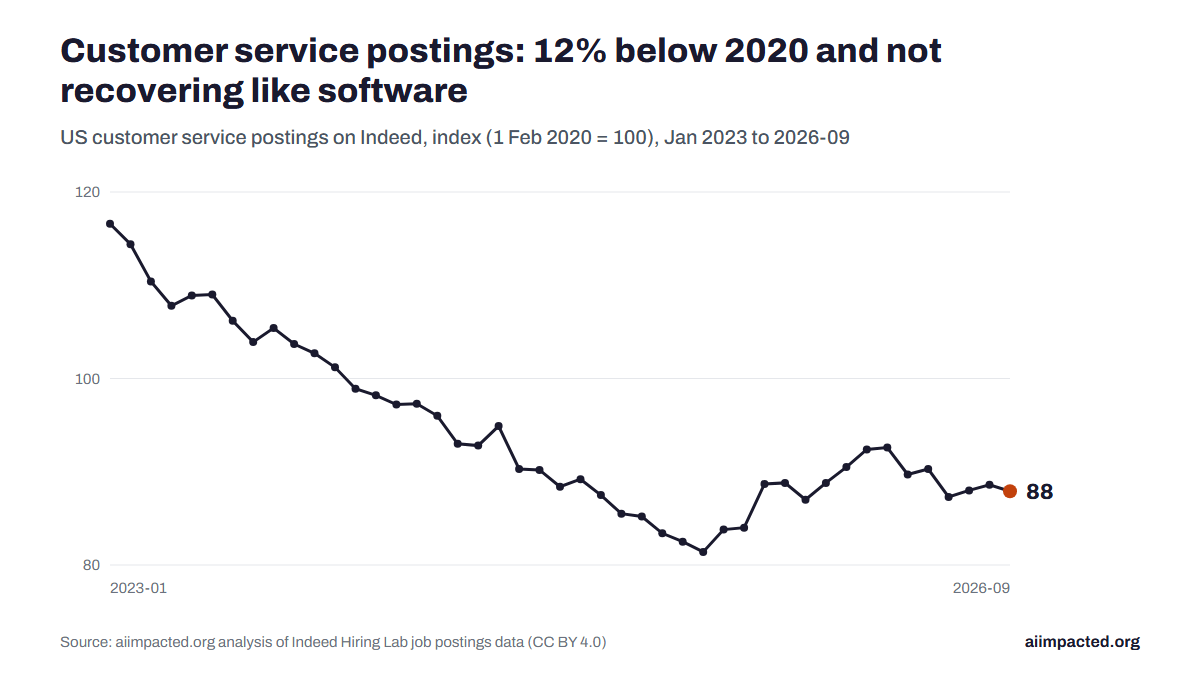
Free to reuse under CC BY 4.0 with the credit: Source: aiimpacted.org analysis of Indeed Hiring Lab job postings data (CC BY 4.0), aiimpacted.org
It is also the occupation where employer claims are most specific. Salesforce gave a before-and-after headcount, and WiseTech Global said it would cut up to half of its customer service and product development staff, mostly outside the US. If AI is going to show up in hiring data anywhere first, customer service is where to look.
#Most employers that blame AI do not say which jobs
There is a limit on what this analysis can test, and it is getting tighter. The table holds thirteen employers, but the tracker holds 42 verified AI-attributed job cuts totalling 81,486 jobs as of 5 October 2026. Most of the rest never say which work AI took over. Visa's chief executive said AI is helping "shape the way work gets done" as it cut 2,600 jobs. Acrisure cited "advances in technology, AI, and digital platforms" for 2,250. Paycom, Freshworks and CrowdStrike credited automation or AI for smaller teams without naming a function. The employers that did name functions recently, among them Lufthansa (administration), Just Eat Takeaway (customer service) and WiseTech, placed the cuts mostly outside the US, where this US postings data cannot follow them.
For workers that vagueness matters. "AI made us more efficient" tells you nothing about whether your role is next. Where a company does name the job, its own words are on its company page here.
#What the data cannot show
The tracker's total, explained in how many jobs has AI replaced, counts announced cuts. Postings measure something different, and the limits matter.
- Postings are not hires and not layoffs. A company can cut 4,000 support staff and keep posting support jobs elsewhere. This data answers whether employers as a whole kept looking for people in the occupation, not what any one employer did.
- The occupations are Indeed's groupings of job titles, and the matches to the functions employers named are ours. Cloudflare's measurers span accounting, legal and management, so we show each. Back-office process work is matched to Administrative Assistance, the closest group but not an exact one.
- One job board, US only. Indeed is the largest US job site but not the whole market. Cuts that fall mostly outside the US, such as WiseTech's in Australia or Cognizant's in India, are not tested here.
- Composition can change inside an occupation. Software development postings can rise while the roles inside the group shift toward AI engineering and away from the junior work employers say agents now do. The index does not see that.
- The window is short. Most announcements are under six months old. This is an early reading, and we will update it as the series extends.
#What this means if you work in one of these jobs
Our survey tracker shows worker confidence at a record low and fear of technology making jobs obsolete at a record high. The postings data is the counterweight. If you work in software, HR, finance or legal and worry that AI announcements mean the hiring market for your job is closing, the data says it is not closing faster than everyone else's, and for software and HR it is opening a little. If you work in customer service, the market is soft but not collapsing; fresh postings are the number to watch. For a broader view, see will AI take my job and what jobs AI will not replace.
#The data and how we measured it
Three files, free to use with credit to AIimpacted and to Indeed Hiring Lab. The first is the monthly postings index from February 2020 for every occupation an employer in our record has named, alongside all US postings. The second is the event table above as data, with each employer's words and WiseTech's two rows flagged as mostly outside the US. The third summarises all 47 Indeed occupations and marks the ones an AI-attributing employer has named. The tracker's full event list is archived with a DOI on Zenodo.
Method. Postings are Indeed Hiring Lab's seasonally adjusted US job-postings index by occupational sector, a seven-day trailing average indexed to 1 February 2020, taken from the Hiring Lab's public repository on 5 October 2026 and read to 25 September 2026. Each job function was matched to one Indeed occupation using the sample job titles Indeed publishes for each sector. For each announcement we take the index on the announcement date (or the last day before it) and the latest reading, and compare the change with the change in the all-postings index over the same days. Fresh postings use Indeed's separate series for postings on the site for seven days or fewer. Employers, dates and job functions come from AIimpacted's verified record, where a function is recorded only when the employer itself named it, and only cuts not stated to fall mostly outside the US are tested.
Download the data
- Monthly postings index, AI-named occupations and all US postings, Feb 2020 to Sep 2026 (CSV) - 80 months, 15 columns
- Each AI-attributed announcement against its occupation's postings (CSV) - 17 rows, incl. 2 WiseTech rows flagged as mostly outside the US
- All 47 Indeed occupations: level, 1-year, 2-year and since-2024 change, peak and trough (CSV) - 47 rows
Free to use with credit to AIimpacted for the analysis and to Indeed Hiring Lab for the underlying postings index, which it publishes under CC BY 4.0.
Questions people ask
- What is the impact of AI on jobs so far?
- In US job postings, small and hard to separate from the wider hiring slowdown. Postings for the occupations employers have blamed AI for fell 40% to 75% from their 2022 peaks to mid-2025, but so did most white-collar postings, and the AI announcements came after that fall. Since mid-2025 most of those occupations have been flat or rising; customer service is still edging down.
- Is AI causing unemployment?
- Not visibly yet in the national figures. US unemployment was 4.1% in August 2026, and Federal Reserve Governor Lisa Cook said on 28 September 2026 that there is "limited evidence" so far of AI changing the structure of the labor market, while pointing to coding and translation as areas where it may be reducing demand. Job postings for the occupations employers say AI replaced are mostly flat or rising.
- Will AI replace programmers?
- Employers including Upwork, ClickUp, Elastic and Redis have said AI let them cut engineering roles. The hiring data does not yet show the market following them: US software development postings on Indeed were 14 points higher on 25 September 2026 than a year earlier, the biggest rise of any occupation employers have blamed AI for. They remain 22% below February 2020, because the fall came between 2022 and 2025, before those announcements.
- Which jobs have employers said AI replaced?
- In AIimpacted's verified record, employers have named customer support (Salesforce, 4,000), HR (IBM, about 200), software engineering (Upwork, ClickUp, Elastic, Redis), middle management (Coinbase, Cloudflare, Upwork), finance, legal and audit (Cloudflare), back-office and business services work (Citigroup, C.H. Robinson, Baker McKenzie), marketing content (Gambling.com) and financial planning (Domain Money). Most employers that blame AI, including Visa and Acrisure, do not name the jobs.
- Which jobs are being posted least compared with before the pandemic?
- Data and analytics postings are 38% below February 2020, the lowest of all 47 Indeed occupations, followed by IT operations and support (31% below), media and communications (29%), IT systems (24%), marketing (24%) and software development (22%). All are desk jobs of the kind employers have linked to AI, but the falls mostly happened before the AI announcements.
- Do job postings measure job losses?
- No. A posting is an employer's intention to hire, not a hire and not a layoff. Postings can stay flat while a company cuts staff, if it is still hiring for other roles. The data in this article shows whether employers as a whole kept looking for people in the occupations AI was said to have replaced.