What jobs will AI not replace? The sectors no employer has claimed
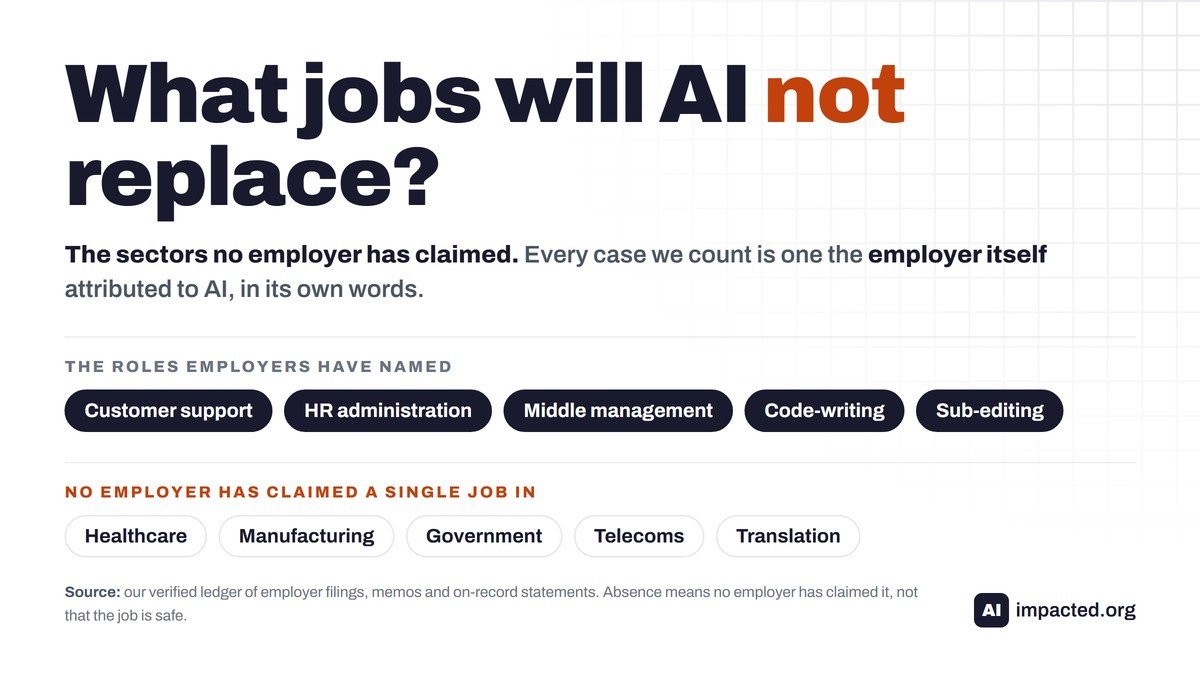
Short answer: No employer has yet attributed job losses to AI in healthcare, manufacturing, government, telecoms or translation - five sectors with zero verified entries. Three industries, finance, IT and logistics, hold 86% of all 81,486 verified AI-attributed job losses. But the record only counts what employers announce, so it is blind to freelance and commissioned work that disappears without any announcement. Absence means nobody has claimed it, not that the job is safe.
Ask what jobs AI cannot replace and you get a list: nurses, plumbers, electricians, therapists, chefs. The lists are plausible, they are everywhere, and not one of them counted anything. They are predictions about a future nobody has to be right about.
There is a version of the question that can be checked. Not which jobs could AI do, but which jobs has an employer actually said AI took - in a filing, a memo, or on the record. We have been keeping that list since May 2025, and have since traced it back to January 2025. As of 3 October 2026 it holds forty-two employers and 81,486 jobs, drawn from 150 job-loss stories we checked one at a time.
This article is about everything that is not on it. That absence turns out to be more informative than the list itself - and more complicated than it looks.
#What jobs will AI not replace? Start with what no employer has claimed
The verified record is extraordinarily narrow. Three industries - banking and finance, information technology, and transport and logistics - account for 69,887 of the 81,486 jobs, or 86%. Everything else in the entire economy shares the remaining 14%.
And several large sectors have no verified entry at all:
| Sector | Verified AI-attributed job losses |
|---|---|
| Banking and finance | 35,050 |
| Information technology | 29,450 |
| Transport and logistics | 5,387 |
| Customer support | 4,000 |
| Software development | 3,240 |
| Retail and e-commerce | 1,400 |
| Entertainment and gaming | 1,200 |
| Other (a home-interiors company; a law firm’s back office, no count) | 1,000 |
| Human resources | 740 |
| Media and journalism | 19 |
| Hospitality and travel | two employers, no headcount disclosed |
| Marketing and advertising | one employer, no headcount disclosed |
| Healthcare | none |
| Manufacturing | none |
| Government and public sector | none |
| Telecoms | none |
| Translation and localisation | none |
If you work in healthcare, manufacturing, construction, education or the public sector, here is the honest position: in twenty months of looking, we have not found a single employer in your sector telling anyone - a regulator, a newsroom, or its own staff - that AI did the work and the jobs went. Not one.
#The most-predicted casualty of all has zero entries, and the reason matters
Translation is the canonical example of a job AI takes. It has been the example for a decade. Our record contains no verified translation job losses whatsoever. Even DeepL, which makes one of the tools, put its cut of about 250 roles down to AI without saying that translators were among them.
That is not because translators are fine. It is because of how the work disappears.
Our standard requires an employer to announce something. That catches a bank cutting 20,000 staff. It completely misses the way most translation work has actually gone: a client stops sending files. An agency's order book thins. A freelancer's regulars go quiet, one by one, and nobody ever files a notice or writes a memo, because from the client's side no job was cut at all - they simply bought less.
If you are freelance, contract, or agency-supplied, the thing that takes your income will probably never be announced. There is no memo to find. That is the single most important limitation of every AI job-loss tracker including ours, and you should weigh it before you read any absence on this page as reassurance.
The same blind spot covers work that is quietly not commissioned: illustration, copywriting, voice work, stock photography, entry-level research. Sectors can look empty here while the people in them are losing income steadily.
Manufacturing's zero should be read the same way. Hyundai plans to put Boston Dynamics' Atlas humanoids on parts sequencing at its Georgia Metaplant from 2028, with component assembly by 2030, and to build a production line for 30,000 robots a year. Hyundai's own framing is that robots take the labour-intensive and high-risk tasks while people move to training and oversight. If fewer people end up doing that work, it will most likely show up as a plant that hires fewer of them, not as a layoff memo - the same blind spot as translation. An empty row here means not announced, not safe.
#What every named role has in common
Where employers have pointed at specific work, the pattern is not what the listicles predict. They do not name the manual jobs. They name the middle.
Salesforce named customer support. IBM named HR administration - its chief executive said an internal assistant now handles the routine queries. Infopro Digital named sub-editing. ClickUp named code-writing, its founder saying his engineers are not writing code. They're directing agents that write code.
Domain Money cut half its financial planning team. And Cloudflare's chief executive gave the clearest description anyone has offered of who went: he called them the measurers
- middle management, finance, legal and audit.
Read those together and a shape appears. The named roles are intermediaries. Work arrives as a request, passes through a person who checks it, formats it, approves it or summarises it, and leaves as a document or a decision. The person in the middle adds judgement, but the judgement is recorded, reviewable and mostly consistent - which is exactly the shape a model can be trained on.
What is absent from the list is work that ends somewhere a model cannot reach: in a body, in a building, in a room with another person, or in a decision nobody wrote down.
#Three questions to ask about your own job
This is more useful than a sector, because the exposure follows the function, not the industry. A payroll administrator in a hospital has more in common with the roles on our list than a nurse in the same building does. Ask:
1. Does your work arrive as a request and leave as a document? If the input is a query, a form or a ticket, and the output is text, a number or an approval, that round trip is the shape every named role shares.
2. Could someone reconstruct your day from your screen? Work that happens entirely inside software leaves a training set behind it. Work that happens in a corridor, a van, a ward or a workshop does not.
3. Does somebody check your output before it counts? Roles whose work is reviewed downstream are easier to automate than roles that carry final responsibility, because the review catches the errors a model makes. Cloudflare's measurers
were, precisely, the checking layer.
Three yeses does not mean your job goes. It means your job has the shape of the ones that have.
#Why "not on the list" is not the same as safe
Three cautions, and we would rather lose your confidence than have you misread this.
Absence is not evidence. Every entry requires an employer to have said it out loud. Companies have strong reasons not to: saying AI replaced people invites questions from regulators, customers and the staff who remain. Silence is the cheaper option and most firms take it.
The record is young. Twenty months, forty-two employers. Healthcare had no entry in the first month either.
The ladder breaks before the job does. The clearest harm in the data is not to people in post but to people trying to get in. Stanford Digital Economy Lab, using ADP payroll records, found employment for 22 to 25 year olds in AI-exposed occupations fell about 11% since late 2022 while their less-exposed peers grew. Indeed's hiring data shows the entry-level share of postings in the most AI-exposed occupations falling from 29% to 10% between 2021 and 2026. Your job can be perfectly safe while the job you would have been hired into stops existing.
#If your employer starts blaming AI, here is how to check
This is the part you can use directly, because most announcements that sound like AI replacing people are not.
Of our forty-two employers, only fourteen said it in a regulatory filing - Oracle, HP, Cognizant, Angi, Coinbase, C.H. Robinson, Groupon, Gambling.com, WiseTech Global, OpenText, Paycom, CrowdStrike, Fiverr and Jumia - where being wrong carries legal consequences. The other twenty-eight said it in a memo, a shareholder letter or an interview, where sounding decisive costs nothing.
Gartner has a name for the gap: companies cut for ordinary budgetary reasons and then cite AI because it makes them look better
. Blaming a machine reads as strategy. Admitting you overhired reads as a mistake. When we read the source documents on 150 job-loss stories, nearly three in four turned out not to contain the employer claiming AI did the work at all.
So when the announcement comes, ask four things: Was it said in a filing, or a press release? Does it name the work AI now does? Is there a number attached to the AI itself, rather than to the layoff? And is the company still hiring elsewhere?
If the answer to all four is no, you are probably looking at a cost decision wearing a better story - and that matters to you, because the two have very different implications for whether the work comes back.
#The short version
No employer has yet said AI took a job in healthcare, manufacturing, government, telecoms or translation. Eighty-six per cent of everything that has been claimed sits in three industries. The roles employers name are the intermediary ones - support, HR admin, sub-editing, code-writing, and the checking layer in the middle of large organisations.
But the record only sees what employers announce, and the way most freelance and commissioned work is disappearing will never be announced by anyone. Read the absences as a map of what has been said, not a map of what is safe.
Every figure above comes from our own ledger, and every entry in it links to the filing, memo or interview it came from. We would rather you checked.
Questions people ask
- What jobs will AI not replace?
- On the verified record, no employer has yet said AI took a job in healthcare, manufacturing, government and the public sector, telecoms, or translation. Those five sectors have zero entries across twenty months. That means no employer has made the claim, not that the roles are safe.
- Which jobs are safe from AI?
- None can be called safe from this evidence. What the data shows is where claims have and have not been made. The roles employers do name are intermediary ones - customer support, HR administration, sub-editing, code-writing and the middle-management checking layer. Work that ends in a body, a building or an unrecorded human decision is absent so far.
- Why are there no verified AI translation job losses?
- Because of how that work disappears. Our standard requires an employer to attribute job cuts to AI. Translation work mostly goes when clients quietly commission less - no layoff, no notice, no memo - so it is invisible to this measure and to every other tracker built the same way. Freelance, contract and agency work shares that blind spot.
- How do I know if my employer is really cutting jobs because of AI?
- Ask where it was said. Only fourteen of forty-two employers made the claim in a regulatory filing, where being wrong has legal consequences; the rest used memos and interviews. Then ask whether the announcement names the work AI now does, whether a number is attached to the AI rather than the layoff, and whether the company is still hiring elsewhere.