AI job loss in India: what IIT Madras found, task by task, and what the IT filings show
Short answer: AI is not removing whole jobs in India so much as pulling tasks out of them, and the damage is uneven. A task-based study from IIT Madras's Centre for Responsible AI (October 2026) finds the clearest displacement in entry-level call-centre voice support, where it puts a human seat at four to five times the cost per minute of managed voice AI, with routine bookkeeping and legal-research work next. Jobs that rest on trust, negotiation or frontier-level judgment are slower to change. The headcount filings of India's five largest IT firms fit that pattern: together they employed 6,981 fewer people on 31 March 2026 than a year earlier (about 0.5%), but TCS lost 23,460 while Infosys, Wipro and HCLTech grew, and the five were up 5,480 in the June 2026 quarter. This article does not rest on the AIimpacted ledger.
Most coverage of AI and Indian jobs asks one question: will AI take my job? A white paper from IIT Madras's Centre for Responsible AI (CeRAI), published in October 2026, argues that this is the wrong unit. Jobs are bundles of tasks, and AI takes the tasks one at a time, at different speeds in different places. That is a more useful way to read your own risk, so this article walks through what the paper finds, then checks its picture against a source it does not rely on: the headcount that India's biggest IT employers file every quarter.
We read the full paper, "How AI Is Reconfiguring Work in India" (8 pages, CeRAI and the Wadhwani School of Data Science and AI), not the press summaries.
#Key findings
- Tasks go first, jobs rarely vanish whole. In the paper's words, "AI rarely replaces a job wholesale; more often it automates a bundle of tasks within a job." Every job in its sample has been reimagined through task-level augmentation, task reallocation or a new role built around operating the machine, not simply eliminated.
- Displacement is already visible where AI is cheap and "good enough". Routine password resets, order-status queries, appointment confirmations and payment reminders in Tier-1 business-process-outsourcing (BPO) voice support are increasingly handled by voice AI agents, and the paper puts a fully loaded Indian BPO seat at roughly four to five times the per-minute cost of managed voice AI.
- Work that depends on trust or frontier reasoning is changing more slowly. High-value loan and insurance sales, collections, and complex legal research are the paper's examples.
- The filings show a split, not a collapse. The five largest listed Indian IT firms were down 6,981 people (0.45%) over the 2025-26 financial year, yet three of the five grew.
#What the paper finds
The framework has four levels: the task, the job, the occupation and the wider labour-market outcome. A system that can do one task does not remove the job automatically, and a job that shrinks does not necessarily shrink the occupation. The paper then sorts Indian jobs into two regimes: jobs where AI has automated most of the skill bundle and the human is reduced largely to validation, and jobs where the human stays the primary driver and AI is a productivity tool. Each regime splits into policy-relevant sub-types.
It also gives five reasons an employer automates a task: cutting costs, reaching capabilities only frontier-grade AI can deliver, meeting regulatory requirements, improving safety by removing people from dangerous work, and repairing service quality after an earlier failed automation attempt. That list is worth keeping, because it explains why the same technology empties some desks and leaves others untouched. Cost is only one of five.
One feature of the paper deserves credit: it grades its own evidence. A closing table separates measured data (government statistics, audited disclosures) from pilot or vendor claims, industry estimates and forecasts, and it says plainly where India-specific audited figures are missing. Very little of the public debate does this. Where it says a comparison is "weaker" or a figure is "a derived estimate", it means it, and a careful reader should take the same care.
#Where the paper sees displacement
Call-centre voice support. This is the paper's clearest Indian example, and the economic logic is stark: labour is up to 95% of contact-centre operating costs, and the paper's cost table triangulates four India-focused pricing guides to the four-to-five-times gap above. Its conclusion is that even mid-tier models are "cost-effective" in the strict sense, cheaper to run than to pay a human, with no need for cutting-edge capability. The paper's illustrative career path from here runs from Tier-1 voice agent to escalation specialist, then quality evaluator, then AI conversation designer, then operations supervisor, with each step still requiring a person.
Bookkeeping and compliance. Data entry, invoice recognition, bank reconciliation and GST return pre-filling are increasingly handled by tools built for Indian tax rules. The paper notes that independent figures for the time saved are not yet available.
Legal research. AI-assisted research tools have "measurably reduced" the paralegal and entry-associate research burden at large Indian law firms, while reliable case-law synthesis and litigation strategy still need frontier models that are expensive to run at scale.
Quality inspection and design. The paper describes a Hyundai plant near Chennai using AI-assisted visual scanning and digital validation on its assembly process, and a rough cost gap between human and AI-made design assets that it flags as the weakest evidence in the paper.
#Where the paper sees humans staying central
Industry practitioners in Indian financial services report that outbound sales of high-value products, such as large loans and high-premium insurance, convert worse when AI voice agents replace people, because customers, particularly older ones, want a human voice for major money decisions. Collections and recovery calls show the same pattern: negotiation and empathy stay human. The paper is careful that the direction, not the magnitude, is the defensible claim here, since no audited conversion figures exist.
For a worker the practical reading is to look at what share of your day is routine, rule-bound and high-volume, because that is the part cheap AI reaches first, and at what share rests on judgment, trust or accountability.
#A quick way to sort your own tasks
The paper's logic can be turned into a self-check. These are our groupings of its examples, not a score from the paper, and they describe tasks rather than job titles.
| Task type | Example from the paper | Why | Direction |
|---|---|---|---|
| Routine, high-volume, scripted | Password resets, order status, payment reminders | Cheap voice AI is good enough and the cost gap is large | Exposed now |
| Rule-bound paperwork | Invoice matching, bank reconciliation, GST pre-filling | Tools built for Indian tax rules do the first pass | Exposed, human sign-off remains |
| First-pass research | Legal case-law search for paralegals and junior associates | Research burden measurably reduced at large firms | Changing fast |
| Inspection against a standard | Visual quality checks on a car assembly line | Cameras plus digital validation scale cheaply | Changing, plant by plant |
| Negotiation and trust | High-value loan and insurance sales, collections | Customers want a human; conversion falls with AI voice | Slower to change |
| Dangerous physical work | Sewer and manhole cleaning | The paper argues humans should not do it at all | Replacement welcomed |
Try it on your own week: our task exposure check turns your real tasks into a 40-tile week, shows the evidence behind each group, and gives you a card to download. It runs in your browser and stores nothing.
#How to read the numbers that travel with the paper
Several figures quoted alongside the paper are easy to misread, mostly because they are forecasts or rates that lose their label when repeated. The paper itself labels them correctly; the secondary versions often do not.
| Figure | What it is | What it is not |
|---|---|---|
| $80 billion | A 2022 Gartner forecast that conversational AI would cut global contact-centre agent labour costs by $80 billion in 2026 | A measured saving, or an Indian figure |
| 80% | A 2025 Gartner forecast that agentic AI will resolve 80% of common customer-service issues without a human by 2029, cutting costs about 30% | 80% of customer-service jobs gone |
| 37% vs 33% | A Cognizant-Pearson survey of 750 HR leaders: 37% of entry-level tasks in India are already done by AI, against 33% globally | An audited count; the paper files it under vendor and survey claims |
| 150 to 3,000 rupees | A derived cost for one design asset, from an hourly designer rate of roughly 300 to 2,000 rupees | A published price; the paper warns the rate varies widely by source |
#Checking the picture against company filings
The paper also cites a trade-press report that India's top IT firms added only 17 net employees in the first nine months of fiscal 2026. We could not trace that number to a filing, so we tested the same idea against the results the five largest listed firms publish themselves. The headcounts below are each firm's own quarter-end figures.
| Firm | 31 Mar 2025 | 31 Mar 2026 | Change | 30 Jun 2026 |
|---|---|---|---|---|
| TCS | 607,979 | 584,519 | -23,460 (-3.9%) | 593,798 |
| Infosys | 323,578 | 328,594 | +5,016 | 328,062 |
| Wipro | 233,346 | 242,156 | +8,810 | 243,044 |
| HCLTech | 223,420 | 227,181 | +3,761 | 223,889 |
| Tech Mahindra | 148,731 | 147,623 | -1,108 | 146,760 |
| Five firms | 1,537,054 | 1,530,073 | -6,981 (-0.45%) | 1,535,553 |
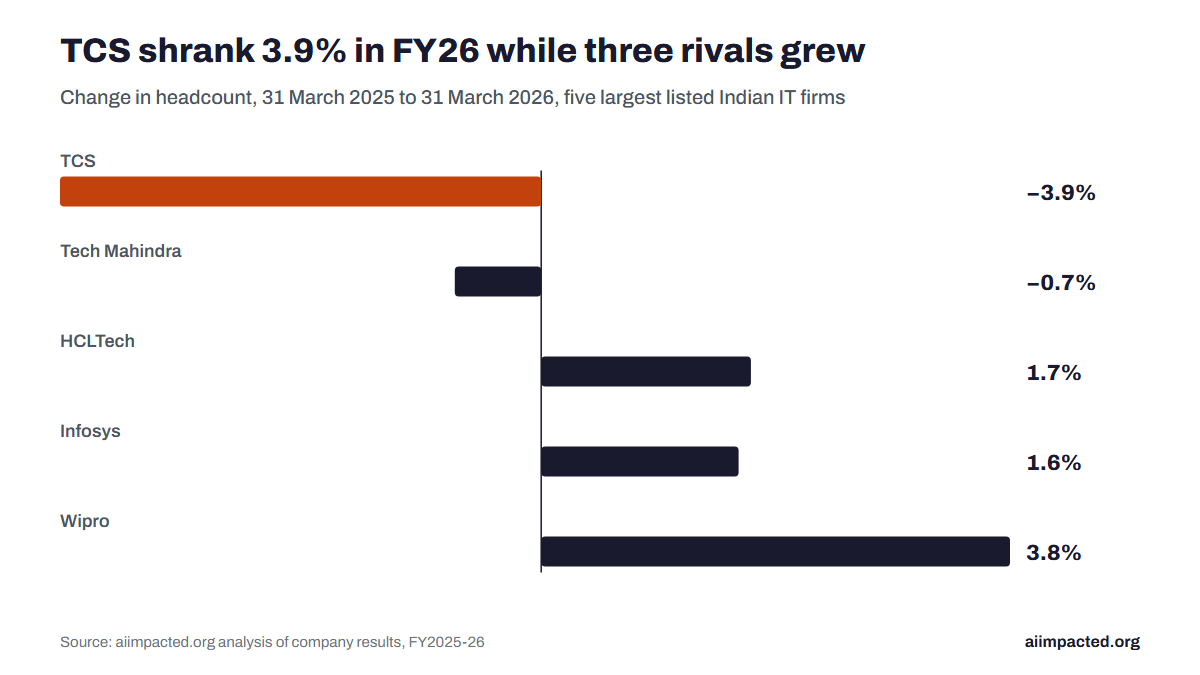
Free to reuse under CC BY 4.0 with the credit: Source: aiimpacted.org analysis of company results, FY2025-26, aiimpacted.org
Three things stand out. First, the sector did not collapse: over a full year the five firms' combined headcount fell less than half of one percent. Second, the fall is almost entirely TCS, with Infosys, Wipro and HCLTech all larger at the end of the year than the start. Third, the latest quarter is up: the five firms added 5,480 people between March and June 2026, led by a 9,279 rebound at TCS, while HCLTech and Tech Mahindra shrank.
On the nine-month claim specifically, the four firms whose December 2025 figures we hold (TCS, Wipro, HCLTech and Tech Mahindra) were together down 13,297 from March 2025. Infosys's own January 2026 release says it has "over 330,000" people, at least 6,422 more than in March 2025, but we could not open its fact sheet for the exact December count, so we cannot reproduce 17 to the person. What the filings support is the shape, which is a flat-to-slightly-down total hiding very different firms. That matches the paper's point that outcomes depend on the employer and the task mix, not on a blanket verdict about "IT jobs".
The same data fits the story in our earlier analysis of Indian IT layoffs and the housing market: the job losses are real but concentrated, and national totals hide the detail.
#The big names: Microsoft's voluntary exit offer reaches India
Large employers are now testing the same question in public. On 26 October 2026, GeekWire reported that Microsoft is offering voluntary exit packages to roughly 60,000 employees, about a quarter of its workforce, in the US, Canada, the UK and India. The offer reaches up to level 70, which includes some employees with vice-president titles, with no age, tenure or performance condition.
Two details matter for how to read it. First, 60,000 is the number eligible, not the number expected to leave. Second, Microsoft does not tie the offer to AI: its chief people officer's memo calls it a choice for people "who may be considering a future outside the company", and a spokesperson said it is not a sign the company needs fewer employees. The AI link is the reporter's context, namely heavy spending on data centres and AI infrastructure while investors press on costs. So it is a large and relevant story for Indian staff at Microsoft, but not a case of an employer saying AI is doing the work, and we do not count it as one.
That is the same discipline the IIT Madras paper asks for: separate what an employer says it is doing, what a reporter infers, and what a forecaster predicts.
#What the paper recommends
The three-part policy proposal is constructive, and it is aimed at the people who bear the cost of change: keep encouraging affordable, task-focused AI tools, especially for small businesses; fund India-specific labour-market research, because most of the evidence is borrowed from other countries; and build pathways into new jobs so that workers displaced from one task can move to the next rung. Its entry-level warning is the one to take seriously: if AI absorbs the routine work through which new employees traditionally learn judgment, the ladder needs a replacement.
#What to do with this
- List your tasks, not your title. For each hour of your week, ask whether the work is routine, high-volume and rule-bound (exposed), or rests on trust, negotiation or accountability (slower to change).
- Move toward the oversight layer. The paper's new roles are escalation specialist, quality evaluator and AI conversation designer. They exist because the machine needs someone who can tell when it is wrong.
- Treat forecasts as forecasts. A figure that begins "Gartner predicts" is a projection, not something that has happened.
- Look at your employer, not the sector. TCS and Wipro sit in the same industry and moved in opposite directions last year.
Questions people ask
- Is AI taking jobs in India?
- Yes, in specific tasks and roles, though not in the form of whole occupations disappearing. The IIT Madras CeRAI paper finds the clearest displacement in entry-level call-centre voice support, with routine bookkeeping and legal-research work also affected, while jobs resting on trust, negotiation or frontier-level judgment change more slowly. India's five largest IT firms together employed 6,981 fewer people on 31 March 2026 than a year earlier, almost all of it at TCS.
- Which jobs in India are most exposed to AI?
- Per the paper, the most exposed work is routine, high-volume and rule-bound: Tier-1 BPO voice support (password resets, order status, appointment confirmations, payment reminders), data entry and GST bookkeeping, and the research layer of legal work. The paper says a fully loaded Indian BPO seat costs roughly four to five times as much per minute as managed voice AI.
- Will 80% of customer-service jobs disappear in India?
- No source says that. The 80% figure is a 2025 Gartner forecast that agentic AI will autonomously resolve 80% of common customer-service issues by 2029, with costs falling about 30%. It is a share of issues, not jobs, it is global, and it is a forecast.
- Did India's top IT firms really add only 17 employees in nine months?
- The figure comes from a trade-press report cited in the IIT Madras paper, and we could not trace it to a filing. What the firms' own results show is that TCS, Wipro, HCLTech and Tech Mahindra were together down 13,297 between March and December 2025, while Infosys said in January 2026 that it had over 330,000 people against 323,578 in March 2025. Over the full 2025-26 year the five were down 6,981 (0.45%).
- What does the IIT Madras white paper recommend?
- Three steps: keep encouraging affordable, task-focused AI tools, especially for small businesses; invest in India-specific research on AI and jobs; and pair adoption with structured pathways for workers to move into new roles.
- Will AI replace call centre jobs in India?
- Some of them, mainly entry-level voice work on scripted queries. The IIT Madras paper says the cost gap, roughly four to five times per minute against managed voice AI, makes Tier-1 support the clearest case of displacement, and it sketches a path from voice agent to escalation specialist, quality evaluator and conversation designer for those who move up. Complex and emotional calls are changing more slowly.
- Who wrote the IIT Madras report on AI and work in India?
- The Centre for Responsible AI (CeRAI) at the Wadhwani School of Data Science and AI, IIT Madras, in October 2026. It is an eight-page task-based framework titled "How AI Is Reconfiguring Work in India", and it labels each of its figures as measured, vendor or pilot claim, industry estimate or forecast.
- Are Indian IT companies laying off because of AI?
- Headcount alone cannot say. The five largest listed firms were down 0.45% over FY26, nearly all at TCS, and up 5,480 in the June 2026 quarter. A fall in headcount shows fewer people, not the reason, and the firms' filings are the place to look for what each says about AI.
- Is Microsoft's 60,000 voluntary exit offer an AI layoff?
- Not on Microsoft's own account. GeekWire reported on 26 October 2026 that Microsoft is offering voluntary exits to roughly 60,000 eligible employees, including in India, about a quarter of its workforce. Microsoft's memo and spokesperson draw no AI line, and 60,000 is the number eligible, not the number expected to leave. The AI link comes from reporting about its AI infrastructure spending.