Are IT layoffs sinking Bengaluru and Hyderabad home prices? Sales held, but unsold homes piled up

Short answer: Not in the way the story is told. India's five largest IT employers ended FY26 with 6,981 fewer people than a year earlier, TCS alone 23,460 fewer, and one private hiring index has Indian white-collar hiring down 9% to 12% on a year earlier every month from June to September 2026. Yet home sales in the four IT cities rose in the first half of 2026: Bengaluru up 5%, Chennai 3%, Pune 2%, Hyderabad 1%, while NCR fell 7%. Prices kept rising too. What did change is the stock of unsold homes: up 44% in Bengaluru, 35% in Pune, 20% in Chennai and 14% in Hyderabad between June 2024 and June 2026, while Mumbai's shrank 5% and Kolkata's 20%. Developers launched far more than they sold, and the IT cities are where the surplus sits.
The story writes itself: India's IT companies are cutting people, most of those people live in Bengaluru, Hyderabad, Pune and Chennai, and a city that loses tech jobs loses home buyers. Reports of falling sales in Bengaluru now routinely name AI-led restructuring as the cause. It is a checkable claim, so we checked it, the same way we tested the H-1B and home prices story in the United States: put the job numbers and the housing numbers side by side, compare the IT cities with cities that are not, and see what moved.
Both sides of the comparison are the primary sources' own figures. Headcount comes from the five largest listed IT firms' quarterly results. Housing comes from Knight Frank India's half-yearly reports on the eight largest markets, which count sales, launches, unsold stock, and prices city by city.
#Key findings
- The IT job cuts are real but concentrated. TCS, Infosys, Wipro, HCLTech and Tech Mahindra employed 6,981 fewer people on 31 March 2026 than a year earlier. TCS alone shed 23,460; the other four added staff. One hiring index, foundit's, has white-collar hiring down 9% to 12% year on year every month from June to September 2026; the other, Naukri's, has it up.
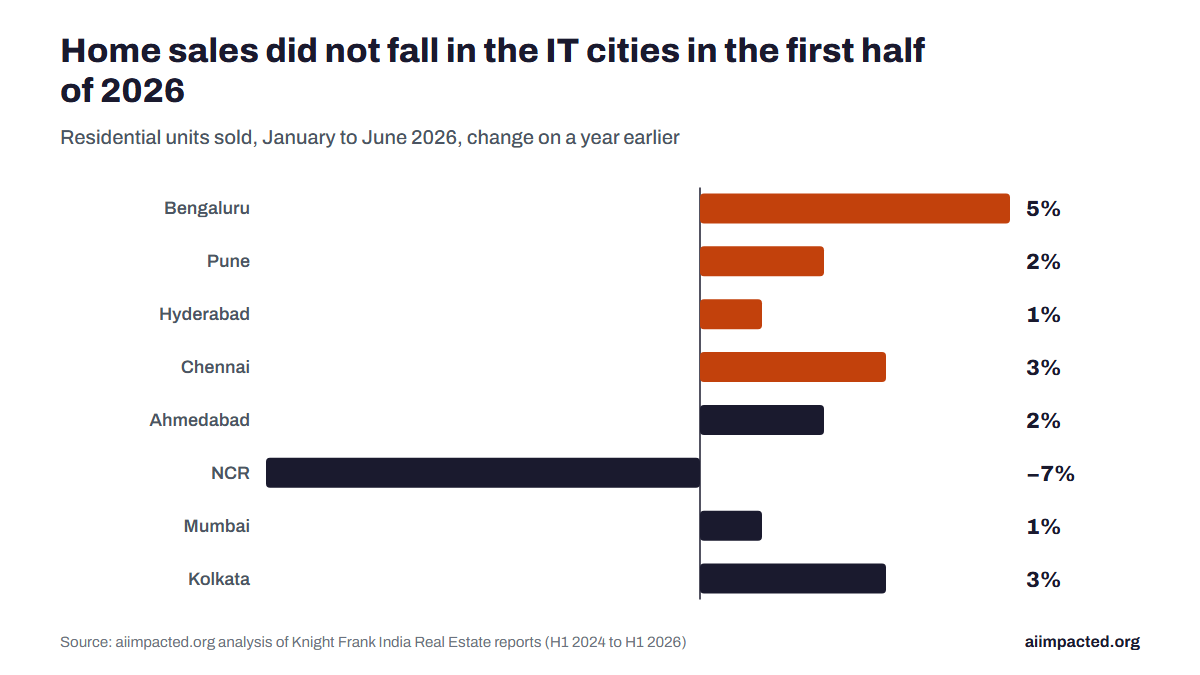
- Home sales in the IT cities did not fall. In the first half of 2026 sales rose 5% in Bengaluru, 3% in Chennai, 2% in Pune and 1% in Hyderabad. The city that fell was NCR, down 7%, which is not an IT market.
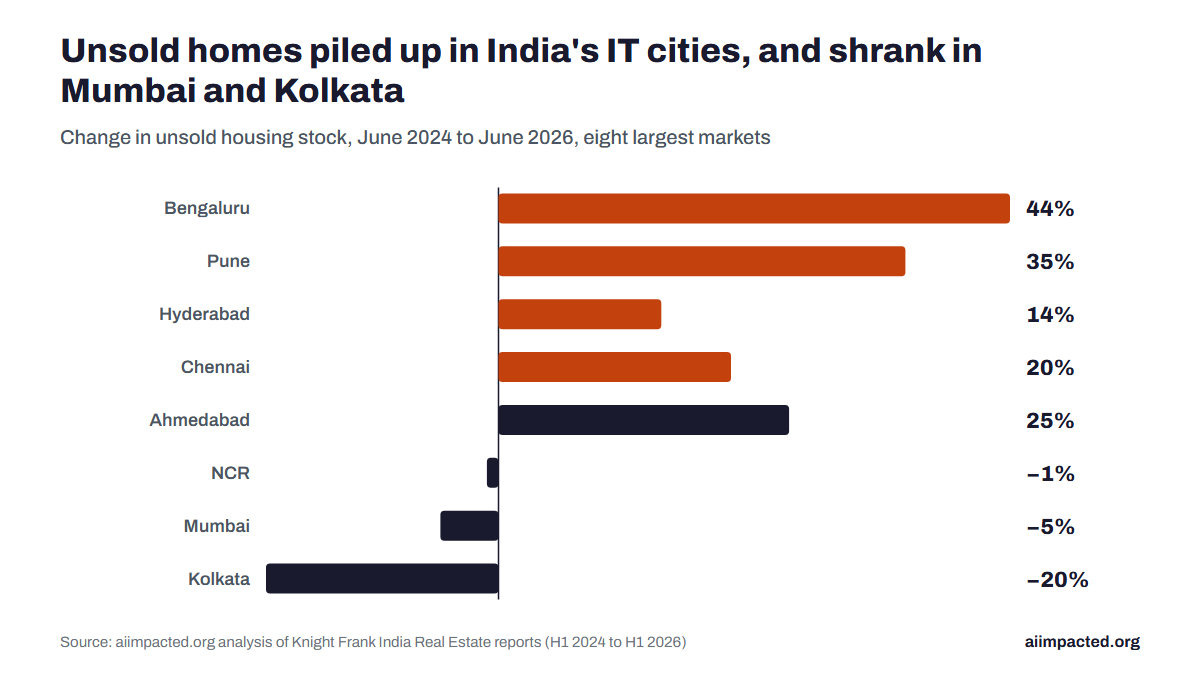
- Unsold homes are where the IT cities stand out. Between June 2024 and June 2026 unsold stock rose 44% in Bengaluru, 35% in Pune, 20% in Chennai and 14% in Hyderabad. Over the same two years it fell 5% in Mumbai and 20% in Kolkata. The IT cities are absorbing supply more slowly, not buying less.
- Prices are still rising, but slower. Bengaluru's average price was 9% higher in June 2026 than a year earlier, down from 12% growth in December 2025. Hyderabad's was 7% higher over twelve months and just 1% over six.
- The surplus is premium, not entry-level. Across the eight cities, unsold homes under 5 million rupees fell 7% in a year and 5 to 10 million fell 3%, while 10 to 20 million rose 12% and 20 to 50 million rose 43%.
#What actually happened to IT jobs
The headline cut belongs to TCS. Its headcount went from 613,069 in June 2025 to 582,163 in December, a fall of 30,906 in two quarters, before recovering to 593,798 by June 2026 and 598,056 by 30 September 2026, a third straight quarter of net hiring according to its own results release of 8 October. HCLTech added 6,450 people in the same quarter, most of them campus hires, by its 12 October release; Infosys and Wipro report later in October. The company's own explanation was a skills mismatch, and its chief executive K. Krithivasan told Moneycontrol in July 2025: "This is not because of AI giving some 20% productivity gains. We are not doing that... It is not because that we need less people." That denial is why TCS sits in AIimpacted's record as an article rather than a counted event. Cognizant is the one large Indian-centred cut that does count: its Project Leap, 12,000 to 15,000 roles mostly in India, was attributed by the company to AI and sits in the tracker.
Across the five firms the net effect over FY26 was small, 1,537,054 people to 1,530,073, because Infosys added 5,016 and Wipro 8,810. The hiring market is harder to read. foundit's tracker of white-collar postings was 9% below a year earlier in June 2026, 12% below in July, 10% below in August and 11% below in September. Naukri's JobSpeak index for the same months rose 6% and 14%, and in September 2% (3,053 against 3,002 a year earlier), with IT and software hiring down 4%. The two count different sites and different jobs, and on AI they agree: both report AI and machine-learning roles growing 20% to 30% while IT services hiring is flat.
#Sales held in every IT city
If job losses were emptying the IT cities of buyers, sales would show it first. They do not.
Free to reuse under CC BY 4.0 with the credit: Source: aiimpacted.org analysis of Knight Frank India Real Estate reports (H1 2024 to H1 2026), aiimpacted.org
| City | Sales H1 2026 | vs H1 2025 | vs H1 2024 | Unsold, Jun 2026 | 2-year change | Quarters to sell |
|---|---|---|---|---|---|---|
| Bengaluru | 27,968 | +5% | +2% | 74,299 | +44% | 3.8 to 5.3 |
| Pune | 24,890 | +2% | +1% | 57,879 | +35% | 3.6 to 4.5 |
| Hyderabad | 19,249 | +1% | +4% | 56,095 | +14% | 5.8 to 5.9 |
| Chennai | 9,198 | +3% | +15% | 19,722 | +20% | 4.3 to 4.4 |
| Mumbai | 47,355 | +1% | 0% | 157,410 | -5% | 7.5 to 6.5 |
| NCR | 24,862 | -7% | -14% | 103,984 | -1% | 7.1 to 7.9 |
| Ahmedabad | 9,581 | +2% | +2% | 37,727 | +25% | 7.7 to 8.1 |
| Kolkata | 8,368 | +3% | -8% | 18,578 | -20% | 6.2 to 4.4 |
Knight Frank India, half-yearly reports. Quarters to sell is June 2024 to June 2026.
Other consultancies count differently and some report a fall. PropTiger's quarterly series had Bengaluru sales down 9% and Pune down 21% in the April to June quarter of 2026, and named tech layoffs as a cause. Knight Frank's half-year count, which we use because it is the only series with sales, launches and unsold stock on one basis for all eight cities back to 2024, shows the opposite for the same cities. Where the sources disagree we say so rather than pick the one that fits.
#Unsold homes are the IT-city signal
Free to reuse under CC BY 4.0 with the credit: Source: aiimpacted.org analysis of Knight Frank India Real Estate reports (H1 2024 to H1 2026), aiimpacted.org
This is the pattern that separates the IT cities from the rest, and it runs the same direction in all four. Developers in Bengaluru launched 68,760 homes in 2025 against 55,373 sold, 24% more supply than demand; in Pune the gap was 10%, in Hyderabad 6%. Mumbai and NCR launched less than they sold. So the IT cities' unsold stock grew while the two biggest markets' shrank.
Free to reuse under CC BY 4.0 with the credit: Source: aiimpacted.org analysis of Knight Frank India Real Estate reports (H1 2024 to H1 2026), aiimpacted.org
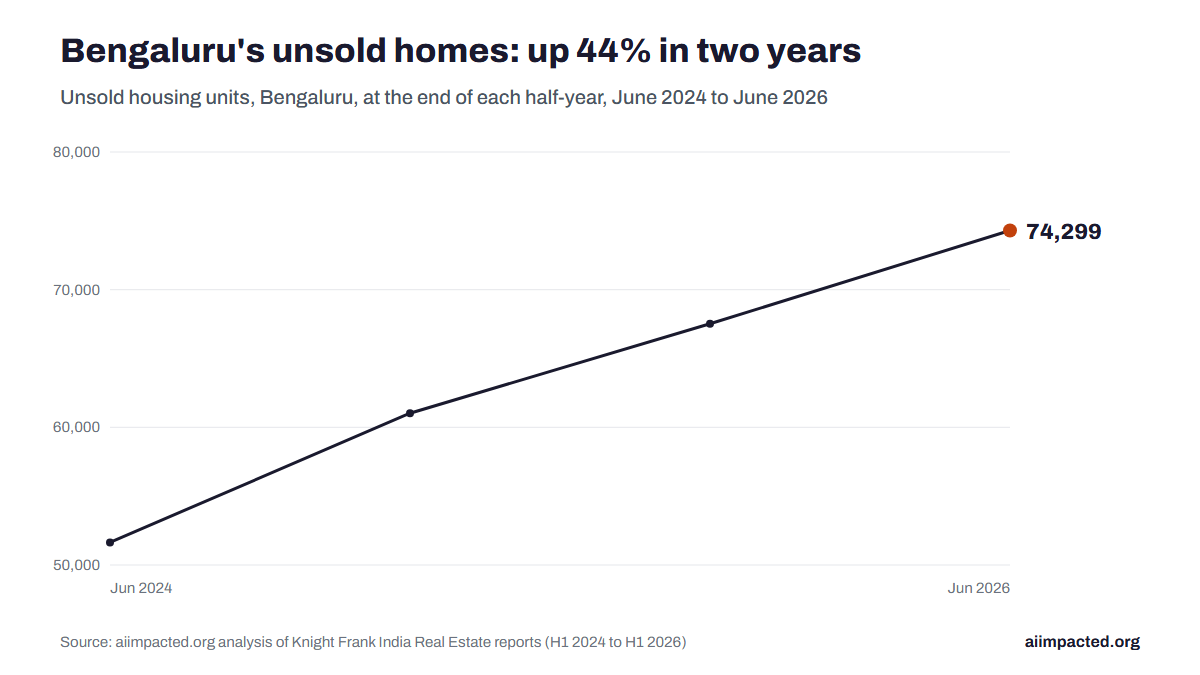
Bengaluru's stock went from 51,643 unsold units in June 2024 to 61,030 a year later, 67,518 in December 2025 and 74,299 in June 2026. The time it would take to sell at the current pace rose from 3.8 quarters to 5.3. That is still a healthier ratio than Mumbai's 6.5 or NCR's 7.9, which is why it does not yet show up as a price fall. It is also exactly what a market looks like when developers planned for a tech-driven demand curve that stopped rising.
Timing fits the jobs data loosely, not tightly. Bengaluru's unsold stock was already up 18% by June 2025, before TCS's two big quarters of reductions. The surplus started as a supply decision. What the job cuts appear to have done is remove the demand growth that would have absorbed it.
#Hyderabad: flat, with one distortion
Hyderabad's monthly registrations, which Knight Frank compiles from the Telangana registration department, tell the same story at a finer grain. Registrations in January to August 2026 were 2% above the same months of 2025, at 50,095 homes. Inside that, May jumped 35% year on year as buyers rushed to register before the state raised guidance values on 5 June, June corrected, July was 1% up and August 9% down. Prices rose 7% over the twelve months to June 2026 but only 1% over the last six. A market that is neither falling nor growing.
#What the data cannot show
- Headcount is not location. The five firms report global totals; most staff are in India and most of those in these four cities, but no company publishes a city split. Cognizant's cut is the only one the employer placed in India.
- Two hiring indices disagree, and both are private job boards, not official counts. India has no public layoff-notice register and its official labour survey does not report occupation by city quarterly.
- The official price index is missing. The Reserve Bank publishes a quarterly house price index for 18 cities, but its release files and data portal could not be read by our tools. Prices here are Knight Frank's weighted averages of primary-market transactions, and the H1 2026 report changed the per-square-foot basis, so only the percentage changes are comparable across reports.
- Unsold stock rises for two reasons, more launches or fewer sales, and in the IT cities it is mostly the first. That is a developer decision as much as a buyer one.
- Half-year data is coarse. The next Knight Frank report, for July to December 2026, is the first that will fully overlap the period after TCS's reductions.
#If you work in IT in one of these cities
If you are renting in Bengaluru or Pune and waiting for the layoff wave to bring prices down, the data says it has not happened and there is no sign of it in prices yet. What it has done is give buyers more choice: two years ago a Bengaluru developer had 3.8 quarters of stock to clear, now 5.3, and the surplus is in the 10 to 50 million rupee homes rather than the cheapest ones. That is a negotiating position, not a crash. If you own, the same numbers say the market has stopped rising as fast, not that it is falling.
#Use the data: eight cities, five employers, two hiring indices
Three files, free to use with credit to AIimpacted and to the original publishers named in each row. The city file has sales, launches, unsold stock, quarters to sell and price change for the eight largest markets by half-year from June 2024 to June 2026, with the source report for every figure. The headcount file has the five IT firms' quarter-end employee counts from March 2025 to June 2026, plus the September 2026 figures for TCS and HCLTech, with each company's own document. The third has the two hiring indices and Hyderabad's monthly registrations.
Method. Housing figures were read from Knight Frank India's Real Estate reports for H1 2024, H1 2025, H2 2025 and H1 2026 (the tables headed Residential Sales and Launches, Unsold Inventory, and Weighted Average Price Change). Second-half 2024 sales and launches are the full-year 2024 figure in the H1 2025 report minus the H1 2024 figure. Headcount is each company's reported total at quarter end, from fact sheets, datasheets or SEC filings; TCS's December 2025 figure is from its Q3 FY26 fact sheet as reported in the financial press, because the PDF is not served to automated readers; the September 2026 figures for TCS and HCLTech are from their results releases of 8 and 12 October 2026, and the September hiring indices are Naukri's own JobSpeak report and press coverage of foundit's tracker, which the job board had not yet published on its site when this was written. The IT-city grouping is Bengaluru, Hyderabad, Pune and Chennai; the comparison group is Mumbai, NCR, Ahmedabad and Kolkata. No regression is run: with eight cities and four half-years there are too few observations for one, so the piece reports the raw comparison and the one pattern that is consistent across all four IT cities.
Download the data
- Eight cities, five half-years: sales, launches, unsold, QTS, price change (CSV) - 40 rows, source PDF per row
- Five IT firms, quarter-end headcount, Mar 2025 to Sep 2026 (two firms for Sep) (CSV) - 29 rows, company document per row
- foundit and Naukri hiring indices; Hyderabad monthly registrations (CSV) - 13 rows
Free to use with credit to AIimpacted for the compilation and to Knight Frank India, the companies named and the job boards for the underlying figures, which remain theirs.
Questions people ask
- Are home prices falling in Bengaluru because of IT layoffs?
- No. Knight Frank's weighted average price for Bengaluru was 9% higher in June 2026 than a year earlier, and 5% higher than six months earlier. Growth has slowed from 12% in December 2025, but it has not turned negative. The visible change is in unsold homes, which rose 44% in two years to 74,299 units, and in how long they take to sell, up from 3.8 quarters to 5.3.
- Is the Hyderabad property market slowing down?
- It has flattened rather than fallen. Sales in the first half of 2026 were 1% higher than a year earlier, prices were 7% higher over twelve months but only 1% higher over six, and monthly registrations in August 2026 were 9% below August 2025 after a rush in May ahead of higher guidance values. Unsold stock is up 14% in two years.
- How many jobs have Indian IT companies cut?
- The five largest listed firms had 1,530,073 employees on 31 March 2026 against 1,537,054 a year earlier, a net fall of 6,981. TCS accounted for the whole decline and more, going from 607,979 to 584,519, with 30,906 leaving in the September and December 2025 quarters alone. Infosys and Wipro grew. Only Cognizant's Project Leap, 12,000 to 15,000 roles mostly in India, is in AIimpacted's record as an AI-attributed cut; TCS said its reduction was not driven by AI.
- Which Indian cities have the most unsold homes?
- Mumbai, with 157,410 unsold units in June 2026, then NCR with 103,984, Bengaluru 74,299, Pune 57,879, Hyderabad 56,095, Ahmedabad 37,727, Chennai 19,722 and Kolkata 18,578. Mumbai and NCR are large but shrinking; Bengaluru and Pune are smaller but growing fastest.